Carletto Caliari
Carlo Cannovaro Caliari (1570–1596), known often by the affectionate diminutive Carletto, occupied a uniquely challenging yet privileged position within the competitive landscape of late Renaissance Venice. As the youngest son of Paolo Veronese, one of the foremost masters of the Cinquecento, his professional trajectory was inextricably linked to his father’s immense prestige and voluminous output.
Active almost exclusively in Venice, Caliari became the primary artistic legatee upon Veronese’s death, inheriting the expansive studio and the responsibility for completing large, demanding commissions. This inheritance cemented his role, allowing the uninterrupted continuation of the family brand, particularly in the production of monumental decorative schemes. Caliari did not work in isolation; he successfully managed the studio alongside his elder brother Gabriele and his uncle, Benedetto Caliari.
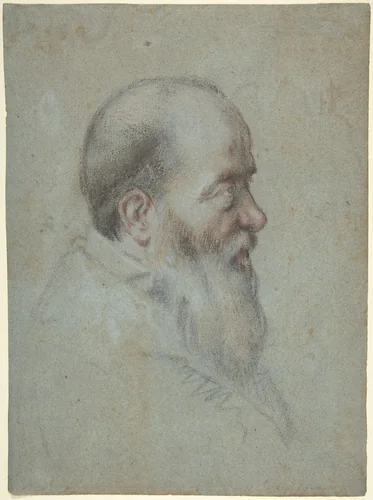
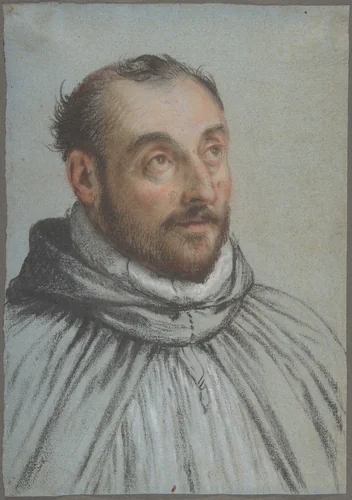
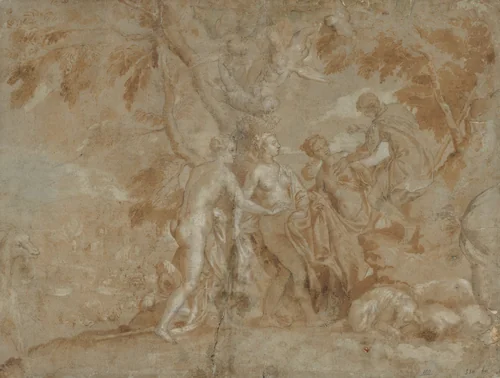
The family workshop was instrumental in completing several colossal narrative pieces, including the famed large pictures of banquets that defined the Veronese style, characterized by shimmering color, theatrical staging, and robust architectural precision. While the attribution in these large Carletto Caliari paintings is often complex due to the collaborative environment, his independent draftsmanship is clearly recognizable in preparatory studies preserved in international collections. Drawings such as Bust of a Bearded Old Man, Profile to Right (Metropolitan Museum of Art) and the mythological composition The Judgment of Paris showcase a hand skilled in capturing movement and expression in the high Venetian manner.
Despite his tragically short life, dying at the age of twenty-six, Caliari’s studio attracted burgeoning talent. Notably, the later Baroque painter Alessandro Turchi spent a formative period working under his direction. It is a curious footnote of art history that for a brief, intense period, a twenty-year-old was in charge of training a future master.
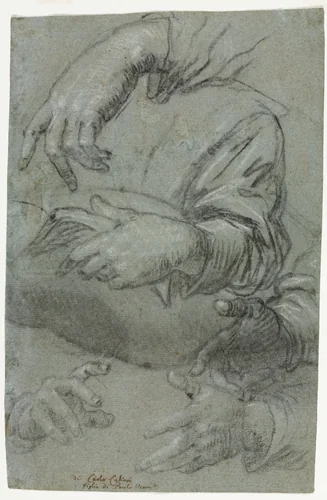
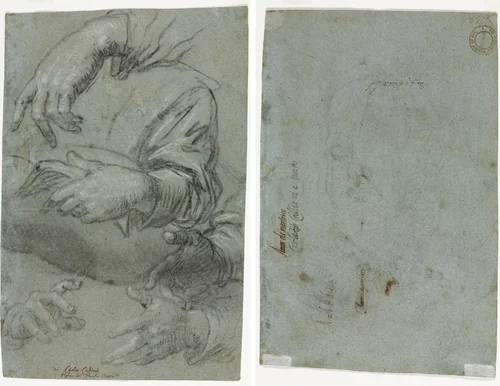
Today, the enduring museum-quality of Caliari’s sketches and figural studies is preserved in institutional collections, including the Cleveland Museum of Art. Since many of these preparatory sheets and studies have passed into the public domain, downloadable artwork and high-quality prints allow wider access to his distinctive approach to detail, exemplified by sheets like Studies of Hands. Caliari’s brief career successfully bridged the transition between the high Renaissance of his father and the ensuing Baroque period in Northern Italy.
Source: Wikipedia · CC BY-SA 4.0