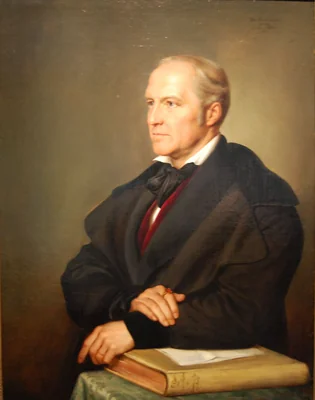
Carl Gustav Carus
Carl Gustav Carus (1789-1869) stands as one of the most distinctive polymaths of the German Romantic era, uniquely fusing the rigorous disciplines of science, medicine, and fine art. Born in Leipzig, his professional life was exceptionally diverse: he excelled as a physiologist, naturalist, scientist, and psychologist, roles that profoundly informed his visual practice. Crucially, Carus was a contemporary and close confidant of Johann Wolfgang von Goethe, participating actively in the intellectual dialogues that defined early 19th-century German culture. His career demonstrates the era’s characteristic belief that scientific inquiry and artistic expression were complementary paths toward understanding the natural world.
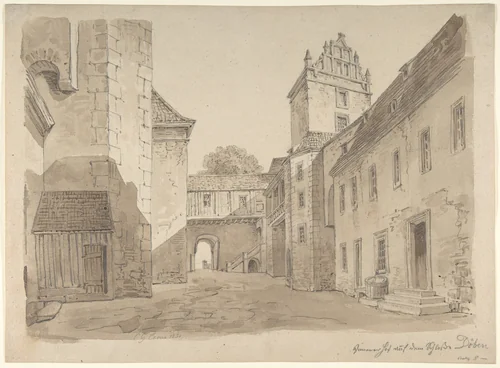
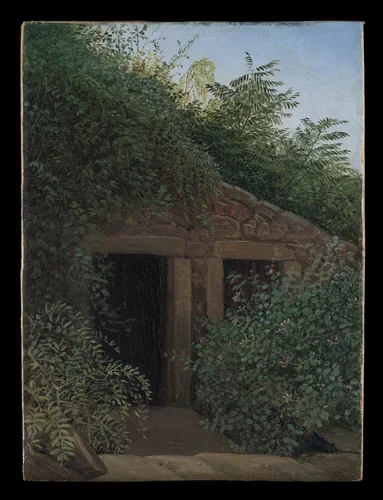
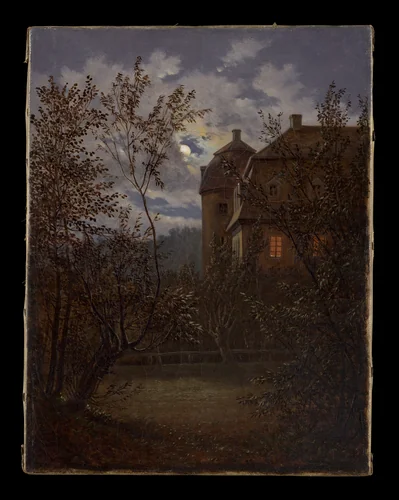
While internationally recognized for his scientific contributions, Carus developed a highly sophisticated painting practice, focusing almost exclusively on the landscape genre. He received tutelage from the pioneering German Romantic master Caspar David Friedrich, adopting Friedrich’s emphasis on spiritualized nature while retaining a distinct clarity and naturalistic detail rooted in his scientific training. His drawings and paintings often capture specific architectural or topographical features with precise clarity, such as the meticulous View of the Courtyard of the Castle at Döben or the evocative, detailed study An Overgrown Mineshaft. Carus particularly excelled at depicting atmospheric effects and nocturnal scenes, utilizing light to explore metaphysical mood, evident in works like Schloss Milkel in Moonlight.
Carus’s approach to landscape painting was formalized in his highly influential theoretical work, Neun Briefe über Landschaftsmalerei (Nine Letters on Landscape Painting). This text established him not merely as a painter, but as a crucial theoretician guiding Romantic visual aesthetics, arguing that art must reveal the Seelenleben (the life of the soul) inherent in nature. The enduring technical quality of his works ensures their status in major institutions; key examples are held by the Metropolitan Museum of Art and the National Gallery of Art. Today, the integrity of Carl Gustav Carus paintings and drawings allows them to be reproduced as high-quality prints for scholars and enthusiasts globally. It is perhaps the highest irony of his career that the eminent physician and scientist produced some of the most emotionally resonant images of the German landscape. Many of these historically significant works are now in the public domain, allowing for downloadable artwork and further critical study.
Source: Wikipedia · CC BY-SA 4.0