Bisson Frères
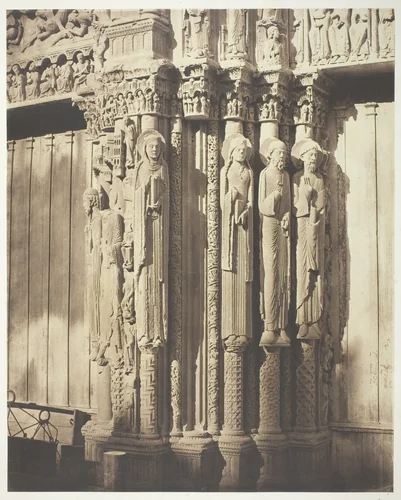
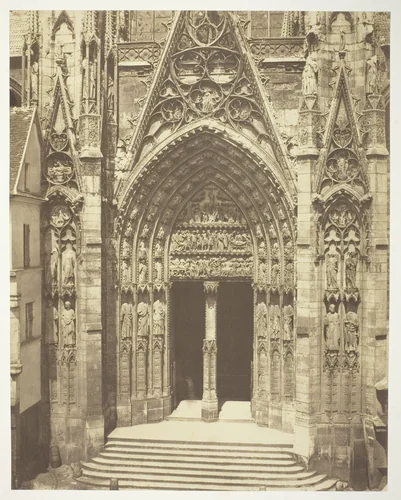
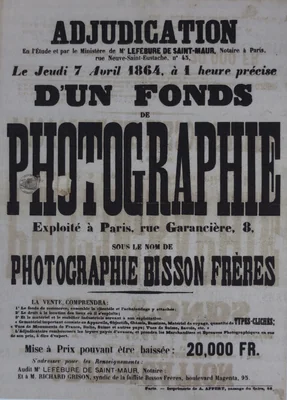
Bisson Frères was the collective designation for a photographic entity, active during a crucial, early period of the medium between 1850 and 1854. Operating during the infancy of architectural photography, their work centered on the documentation of significant European monuments, specializing in detailed, large-format views of historical structures across France and Italy.
The Bisson Frères catalogue focused heavily on rendering the scale and detail of ancient and Gothic architecture. This focus is evidenced by documented photographs such as Amiens Cathedral, West Facade, Central Portal, the French view Portal of Saint-Ursin, Bourges, and the iconic Parisian subject Notre Dame, Paris. Their documentation extended into classical antiquity, featuring early photographic records of structures like the Arch of Constantine, Rome and the Arc de Septime Sévère, Rome.
Fifteen photographs attributed to Bisson Frères are represented in major international museum collections, establishing the entity’s historical significance. These holdings include works at the Metropolitan Museum of Art and the Art Institute of Chicago. Due to the antiquity of the material, much of Bisson Frères's seminal documentation is now considered public domain, allowing for scholarly study and the production of high-quality prints and downloadable artwork.
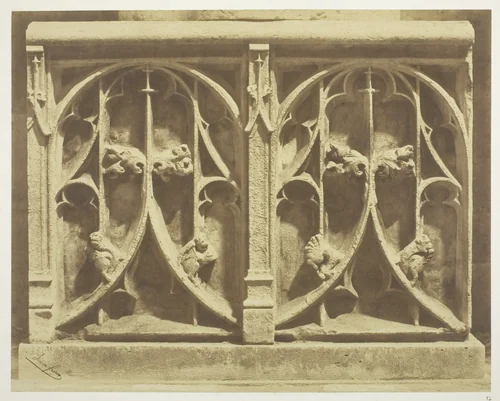
![Untitled [Rome] by Bisson Frères, photograph, 1854-1856](https://img.artbee.org/fe11702f-0905-46e4-b0e1-4abd1cbb6a22/small.webp)
![Untitled [South Façade of the Transept of St Michael’s and St Gudula Cathedral in Brussels, Belgium] by Bisson Frères, photograph, 1854-1855](https://img.artbee.org/662d874f-00ea-4a05-98d2-11a251e6f137/small.webp)