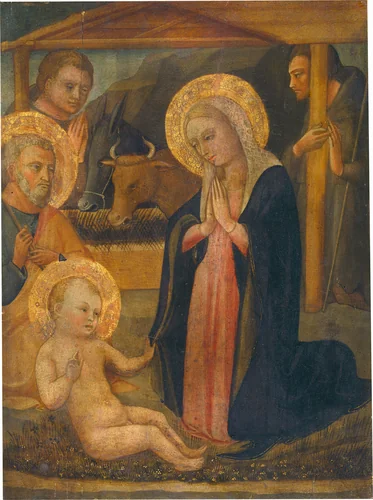
Bicci di Lorenzo
Bicci di Lorenzo (1373–1452) holds a significant position in the historical arc of Florentine painting, active across the pivotal decades bridging the refined ornamentation of the Late Gothic style and the burgeoning, scientific realism of the Early Renaissance. A painter and sculptor, Bicci worked prolifically within his native Florence, maintaining a highly successful and lengthy career that spanned nearly sixty years.
While many contemporaries were embracing the revolutionary approaches to perspective championed by Masaccio and Brunelleschi, Bicci excelled by providing patrons with what they knew and loved: elaborate, gold-infused devotional panels and altarpieces rooted firmly in the tradition of the Trecento. His work is invaluable for demonstrating the continued strength of conservative taste in 15th-century Italy, where a demand for clear, narrative richness often superseded the interest in purely architectural realism. One could observe that Bicci was the astute commercial success story of his era, consistently providing high-quality commissions that met established market expectations.
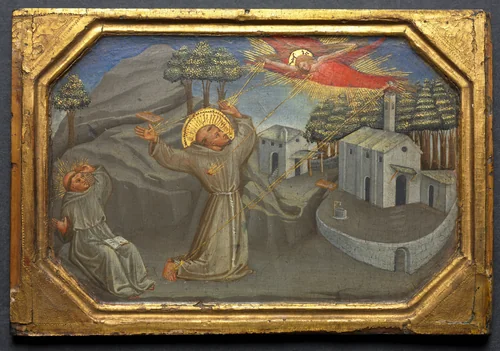
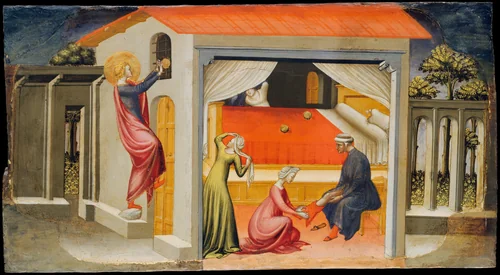
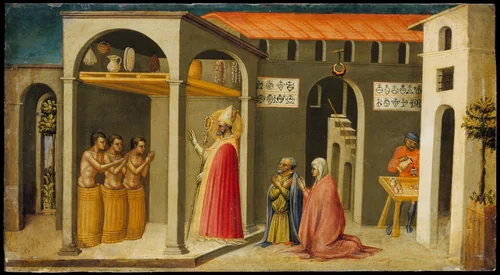
His surviving oeuvre illustrates a mastery of narrative detail, frequently focusing on the lives of saints and biblical figures. Notable examples include St. Francis of Assisi Receiving the Stigmata and the paired panels Saint Nicholas Providing Dowries and Saint Nicholas Resuscitating Three Youths. These works, along with The Adoration of the Christ Child, reveal a skillful draftsman with a penchant for clear, emotionally resonant figures rendered in vivid, saturated colors.
Active between 1425 and 1440 in critical periods of development, Bicci di Lorenzo paintings offer vital context to the history of the period. His legacy is secured through major international holdings, with works residing in prestigious institutions such as the Metropolitan Museum of Art, the National Gallery of Art, and the Cleveland Museum of Art. Due to the historical age of these works, many of the finest Bicci di Lorenzo prints are now widely available, having entered the public domain, allowing for greater scholarly access to this essential transitional figure.
Source: Wikipedia · CC BY-SA 4.0