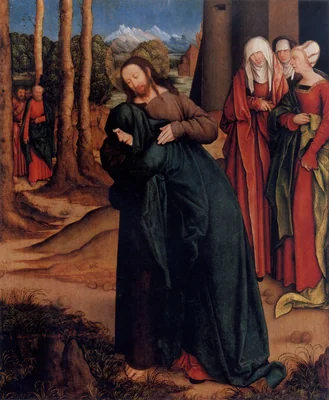
Bernhard Strigel
Bernhard Strigel (circa 1465-1528) was the preeminent painter of the Strigel family dynasty established in Memmingen and a leading exponent of the Swabian school during the German Renaissance. Active primarily between 1510 and 1527, his output centered on formalized portraiture and historical, devotional subjects, characterized by their precise detail and sophisticated engagement with early Netherlandish painting models. Likely trained under Bartholomeus Zeitblom in Ulm, Strigel quickly moved beyond regional patronage to secure commissions at the highest levels of imperial power.
Strigel’s historical significance is inextricably linked to his close relationship with the Holy Roman Emperor Maximilian I. He attained the coveted position of court painter and repeatedly undertook journeys on the Emperor’s behalf to major political and cultural centers, including Augsburg, Innsbruck, and Vienna. This royal favor allowed him unparalleled access to the court and ensured his production of crucial documentary portraits that serve as invaluable records of early sixteenth-century court life and power structures.
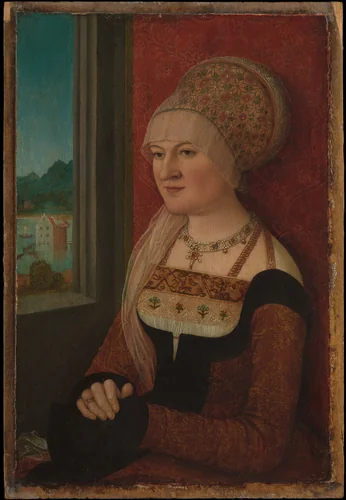
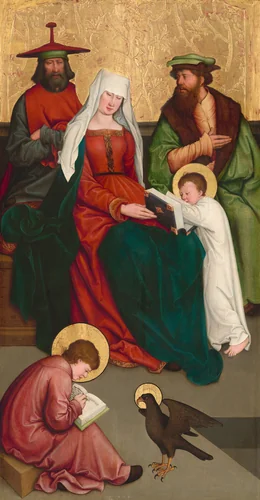
His technical mastery is evident in the surviving body of work, much of which now resides in major global institutions, including the Metropolitan Museum of Art and the National Gallery of Art. While the catalogue of Bernhard Strigel paintings is concise, the extant examples demonstrate his skill in rendering texture and individualized features, whether in the quiet intensity of a devotional panel like Saint Mary Cleophas and Her Family or in the compelling documentation of a civic figure captured in the double-sided panel of Hans Roth. His portraits are not merely records; they are quiet, intense studies where the sitter seems perpetually aware of the artist's scrutiny, a quality that lends them enduring psychological presence.
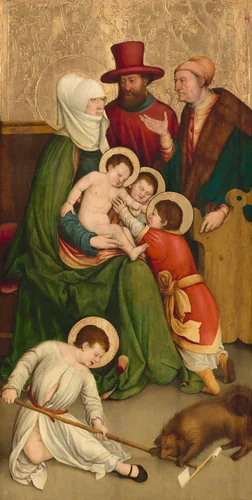
Strigel skillfully navigated the transition between late Gothic precision and the emerging naturalism of the Renaissance. He adapted traditional devotional group portraits, such as Saint Mary Salome and Her Family, to reflect contemporary fashion and family configurations, offering a subtly modern approach to inherited forms. Today, the clarity and superb preservation of his technique ensure that these museum-quality masterpieces remain essential subjects for art history, and much of his work is now available as downloadable artwork, ensuring the wide accessibility of this key figure of the Swabian Renaissance.
Source: Wikipedia · CC BY-SA 4.0
![Hans Roth [obverse] by Bernhard Strigel, painting, 1527](https://img.artbee.org/4ff68fb5-5fa7-42d8-ae88-45b1bf812e7a/small.webp)
![Hans Roth [reverse] by Bernhard Strigel, painting, 1527](https://img.artbee.org/c148d3d9-7b12-41ef-9949-456daccd24d5/small.webp)
![Margarethe Vöhlin [obverse] by Bernhard Strigel, painting, 1527](https://img.artbee.org/d417b002-d406-44c9-9aa7-82d24d14bc04/small.webp)
![Margarethe Vöhlin [reverse] by Bernhard Strigel, painting, 1527](https://img.artbee.org/25475bfe-2ba7-4f7b-9167-ad69c0511300/small.webp)