Bernardo Castello
Bernardo Castello (1557–1629) was a vital figure in the late Italian Mannerist movement, establishing a successful practice primarily in Genoa and the surrounding Ligurian region. Active across the transition into the 17th century, his significance rests primarily on his accomplished historical painting and insightful portraiture, skills that secured him consistent patronage among the region’s elite families and powerful religious orders.
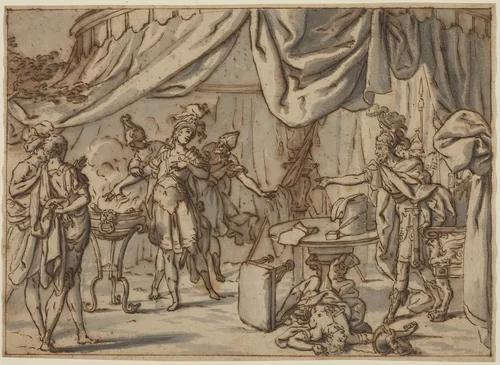
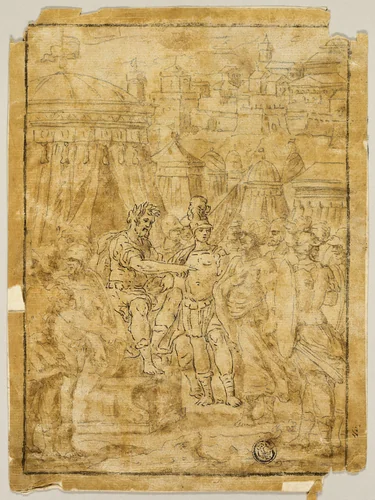
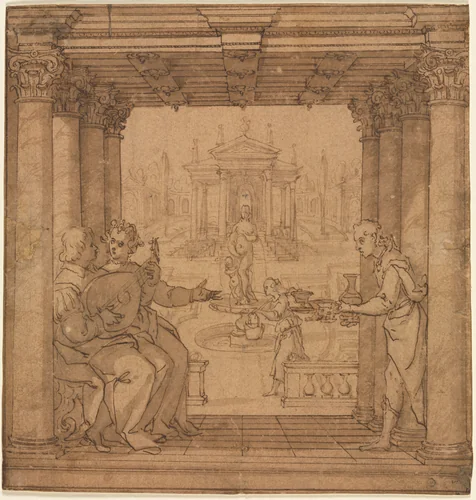
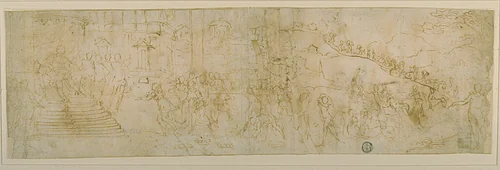
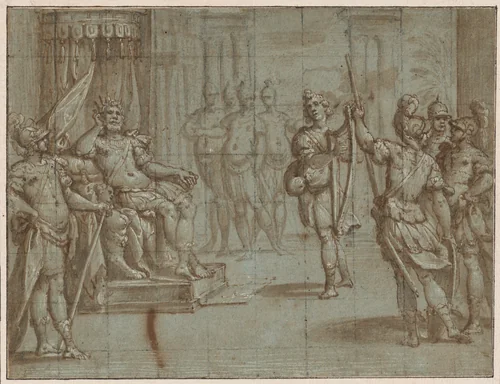
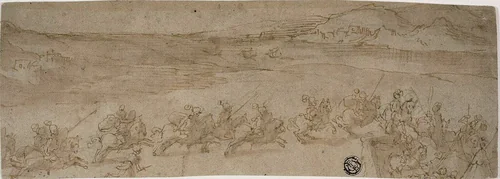
Castello’s artistic output was highly focused on narrative subjects, often drawn from classical antiquity or contemporary literature. His drawings, a crucial component of his surviving oeuvre, demonstrate a sophisticated graphic ability used for complex compositions, such as the dramatic Roman narrative Mucius Scaevola. However, it is his deep association with the epic poetry of Torquato Tasso that provides a specific lens into his influence. Castello executed numerous detailed illustrations for the highly popular Gerusalemme Liberata (The Liberation of Jerusalem), a project that cemented his reputation as a master of dramatic staging and narrative structure, evident in works like the extant Illustration from Torquato Tasso's Gerusalemme Liberata.
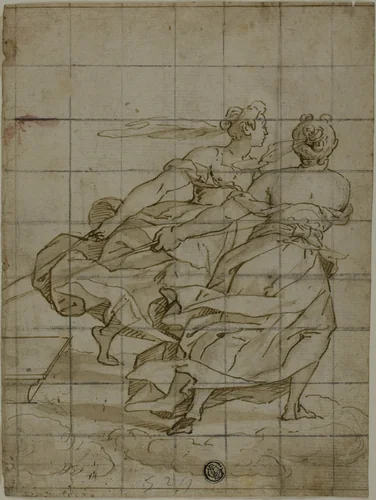
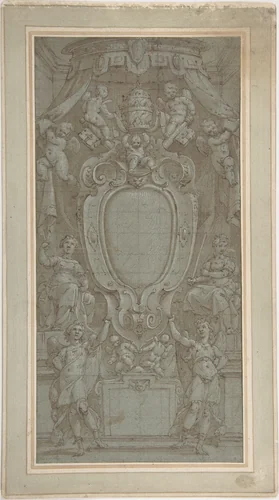
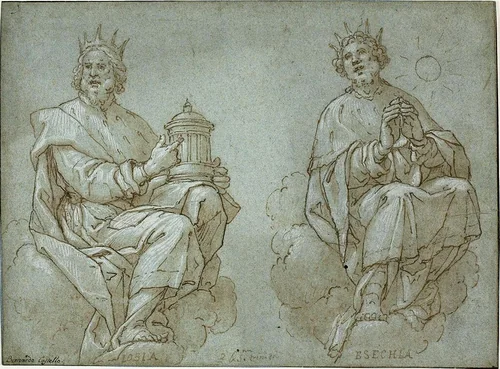
His surviving drawings offer direct insight into his working method, frequently serving as modelli or preparatory sketches for much larger painted cycles and ceiling decorations. A fine example of this is the Modello for Ceiling Fresco with Papal Coat of Arms, which displays the bold foreshortening and dynamism required for grand-scale illusionism. Castello had a notable capacity for handling complex allegorical subjects, as seen in Two Women on Clouds, Pulling a Load, compositions that demonstrate the kinetic energy characteristic of high Mannerism.
Though rooted firmly in the style of the late 16th century, Castello maintained relevance well into the subsequent Baroque era, adapting his compositional language to suit evolving tastes. It is worth noting that he was also an avid reader and close personal acquaintance of Tasso himself, a relationship that surely enhanced the narrative authenticity of his demanding literary commissions. Today, key examples of his œuvre are held in major American institutions, including the National Gallery of Art, the Art Institute of Chicago, and the Cleveland Museum of Art. For scholars and enthusiasts, many of these museum-quality works are available as high-quality prints, ensuring access to the refined aesthetic of the late Genovese Renaissance. These historical Bernardo Castello prints often reside within the public domain, offering broad access to his significant graphic output.
Source: Wikipedia · CC BY-SA 4.0