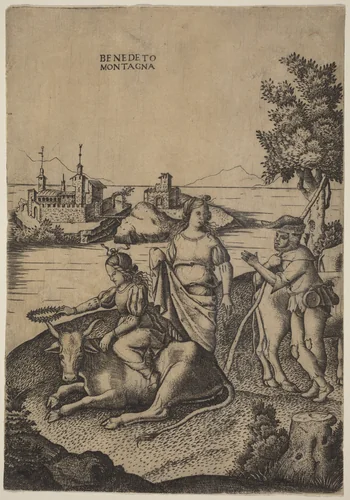
Benedetto Montagna
Benedetto Montagna (active 1497-1510) stands as one of the most prolific printmakers of his generation in Northern Italy during the early sixteenth century. Based in Vicenza, his artistic training was established within the shadow of his father, Bartolomeo Montagna, the city’s leading painter, with whom Benedetto trained and maintained a close, long-term professional relationship. While operating within his father’s established style, particularly in his painted commissions, Benedetto quickly distinguished himself through his focused application of copperplate engraving techniques. He inherited the Montagna workshop in 1523 following his father’s death and continued its operations well into the 1540s, cementing the family’s role in Vicentine artistic production for nearly half a century.
Art historians consistently identify Montagna’s substantial contribution to printmaking as his primary artistic legacy. Over the period from roughly 1500 to 1523, he executed approximately fifty-three engravings, a notable output that placed him at the forefront of the graphic medium in the region. His subjects often drew from devotional themes, such as The Virgin and Child, and narrative compositions exploring classical or biblical figures, including the atmospheric Saint Jerome seated beneath a rocky arch or the mythological study Vulcan, Apollo and Cupid. Montagna’s skill lay in adapting his father’s solid, somewhat archaic painting style to the linear demands of high-quality prints, which were instrumental in disseminating the Montagna aesthetic across the Veneto. It is perhaps one of the great historical ironies that the son of a celebrated painter is remembered predominantly for the works he reproduced in multiples.
In contrast to the refinement found in his prints, Benedetto Montagna paintings often remained firmly rooted in Bartolomeo’s conservative quattrocento manner, failing to fully incorporate the dynamic developments emerging in central Italian Renaissance art. While his surviving painted works are few, they confirm that his strengths lay more squarely with graphic invention than with large-scale color composition.
Montagna’s enduring significance is evidenced by the inclusion of his graphic oeuvre in major global institutions, including the National Gallery of Art, the Art Institute of Chicago, and the Metropolitan Museum of Art. Because many of his earlier works are now in the public domain, they remain widely accessible to scholars and enthusiasts alike.
Source: Wikipedia · CC BY-SA 4.0