Belisario Corenzio
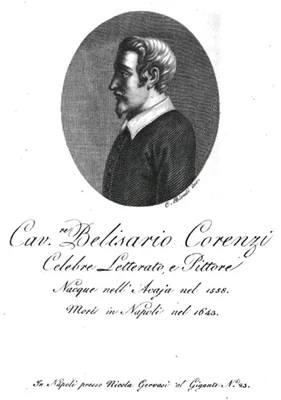
Belisario Corenzio (c. 1558-1643) was a pivotal Greek-Italian painter whose influential career was firmly rooted in Naples following foundational training in Venice. He distinguished himself from his contemporaries by fully rejecting the prevailing maniera greca, the Byzantine-influenced style common among many Cretan expatriates. As a pupil of Tintoretto, Corenzio instead absorbed the grand scale and dramatic lighting characteristic of the Venetian school, aligning himself stylistically with figures like Marco Basaiti and El Greco.
By 1590, Corenzio had settled permanently in Naples at the age of 32, a strategic move that cemented his reputation as the region’s preeminent fresco master. His style evolved, drawing inspiration from Mannerists such as Cavalier d’Arpino, yet achieving a monumental force sometimes likened to the naturalism emerging in the work of Caravaggio. Corenzio’s influence in Naples was vast; he was celebrated for his dynamic architectural decorations, including surviving works in the Church of San Severino and the Certosa di San Martino. Among his most significant commissions is the comprehensive fresco cycle depicting scenes from the Gospel of Matthew, located within the Crypt housing the remains of Matthew the Apostle at Salerno Cathedral.
Corenzio was not only a prolific practitioner but also an important mentor; his apprentices included key Neapolitan figures such as Massimo Stanzione, Andrea di Leone, and Onofrio De Lione. His aggressive professional dominance in the city, however, gave rise to a dark and persistent historical legend. Alongside the Spanish master Jusepe de Ribera and Battistello Caracciolo, Corenzio was allegedly part of the infamous “Cabal of Naples,” rumored to have systematically undermined or poisoned artistic competitors vying for lucrative painting contracts, though definitive documentation for these claims remains absent.
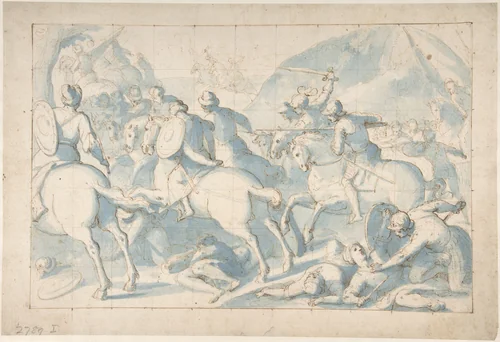
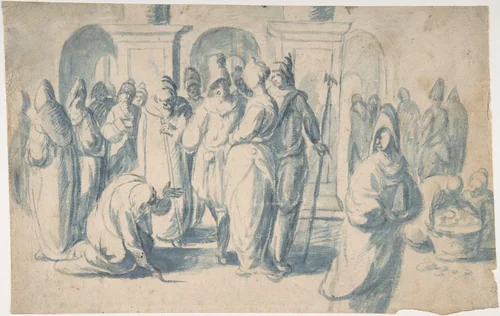
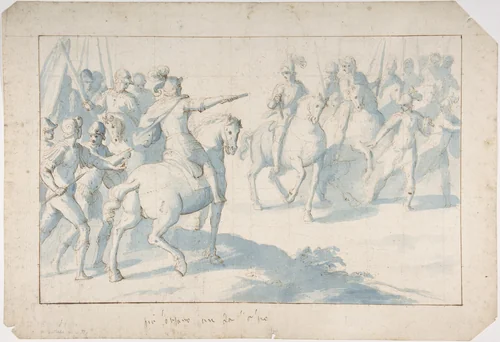
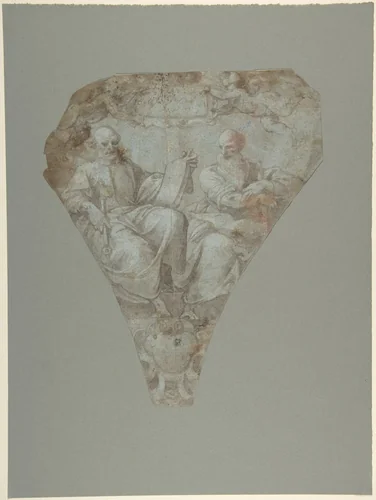
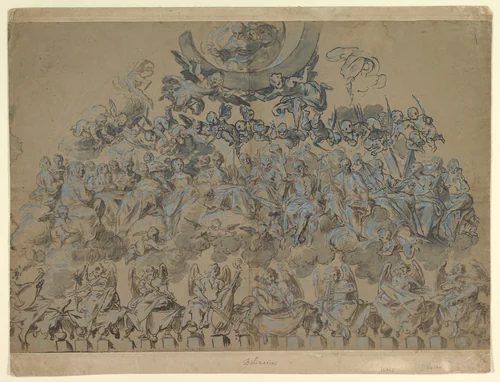
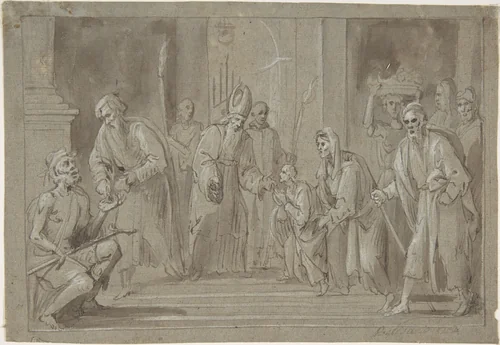
Despite this shadowy folklore, Corenzio’s artistic legacy is robust and widespread. His drawings, crucial preparatory documents for his massive fresco projects, are held in major international collections, including the Louvre, the Museo di Capodimonte, and the Metropolitan Museum of Art. The latter holds works such as the Study for a Pendentive: Figures of Saint Peter and Saint Paul and Christ and the Woman Taken in Adultery. Today, his remarkable Belisario Corenzio paintings and detailed preparatory studies are frequently analyzed in scholarly monographs and are accessible as high-quality prints, illustrating the powerful output of this central figure in Neapolitan Seicento art.
Source: Wikipedia · CC BY-SA 4.0