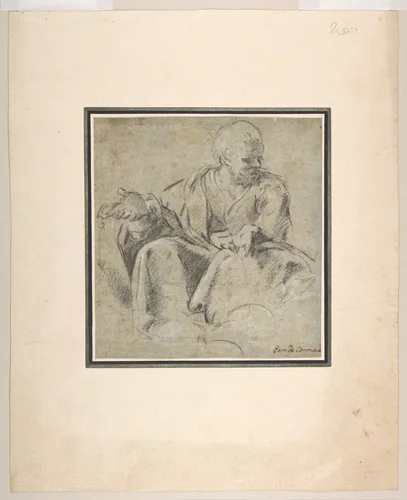
Bartolomeo Schedoni
Bartolomeo Schedoni (1578-1615) established himself as a formative, early exponent of the Italian Baroque style, working primarily in Modena and Parma. Emerging at the confluence of late Mannerism and the nascent classicism of the Carracci, Schedoni developed a uniquely intense and emotionally charged visual vocabulary. His canvases defined the new century's appetite for dramatic narrative, employing a potent chiaroscuro to sculpt figures in three dimensions and elevate devotional fervor. His commitment to palpable humanism, particularly in religious scenes, marked him as a key innovator whose influence spread rapidly across Northern Italy, ensuring that Bartolomeo Schedoni paintings remain central to the history of the region.
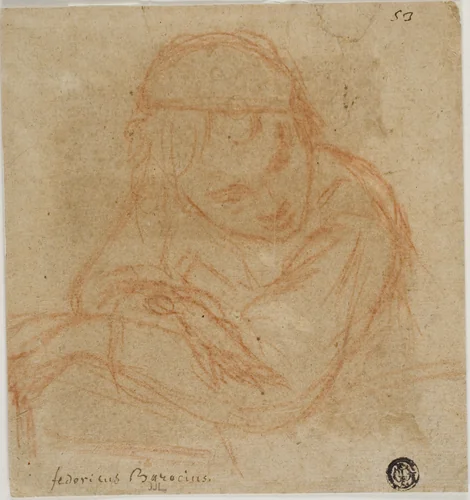
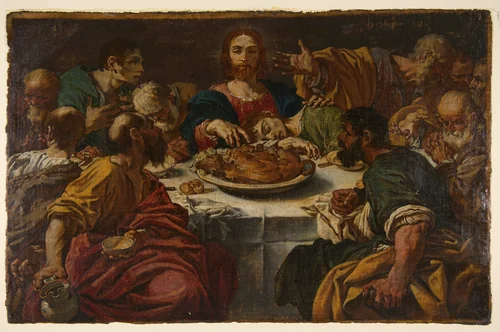
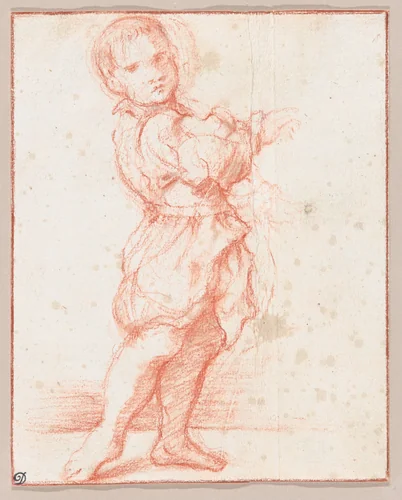
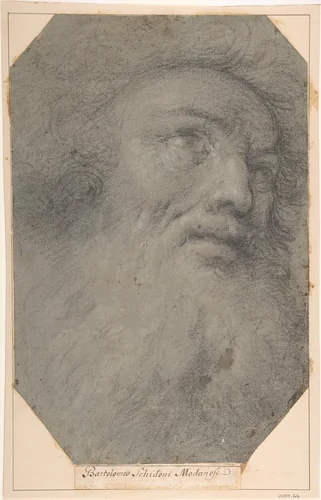
While much of Schedoni’s reputation rests upon his large-scale altarpieces, his profound skill as a draftsman is particularly revealing in his surviving preparatory works. Drawings such as the carefully observed Half Length Sketch of Girl with Crossed Arms and the compositionally complex The Last Supper attest to his reliance on meticulous observation and structural rigor. His figure studies often betray the rapid, yet economic, hand necessary for translating complex psychological states onto canvas, which is particularly evident in the powerful, focused gaze captured in Head of a Bearded Man, Looking up to the Right. Further refinement is seen in his detailed anatomy practice, as demonstrated in the naturalistic pose of Full-length Figure of a Standing Boy. These preliminary documents are crucial to understanding the transition from Renaissance idealism to Baroque immediacy.
Schedoni’s ability to infuse narrative art with genuine human emotion secured his reputation among collectors, ensuring the continued institutional value of his work. Though his career was tragically short-lived, the power of his intense realism confirms his status as a fundamental figure in the development of painting in Emilia-Romagna. His works are held in prestigious venues globally, including the Metropolitan Museum of Art and the Art Institute of Chicago.
For researchers and enthusiasts alike, access to his oeuvre, particularly preliminary works such as Study for a Figure of Saint Joseph, offers invaluable insight into Baroque working methods. Schedoni often favored deeply atmospheric settings in his finished compositions, a clever visual technique that allowed him to enhance the dramatic potential of light and shadow while subtly focusing the viewer’s attention onto the figures. The increasing availability of high-quality prints and royalty-free downloadable artwork ensures that the refined subtlety and dramatic flair of Schedoni’s line work continues to inform contemporary study and appreciation. His surviving output confirms his pivotal position as a master bridging the high Renaissance heritage with the revolutionary spirit of the Baroque age.
Source: Wikipedia · CC BY-SA 4.0