Aurelio Luini
Aurelio Luini (active c. 1540-1580) stands as a key representative of late Lombard Mannerism, working primarily in Milan during a crucial transition period for Italian painting. The fourth and final son of the celebrated high-Renaissance master Bernardino Luini, Aurelio inherited a distinguished artistic lineage, yet he moved decisively toward the expressive, often heightened aesthetic prevalent in the mid-sixteenth century. Operating as both a painter and a highly skilled draughtsman, his surviving works offer insights into the complex preparatory processes of the era.
Luini’s active period aligns him with a generation of artists seeking intellectual and stylistic novelty. He maintained a close friendship with the Mannerist painter and art theorist Gian Paolo Lomazzo, a connection that situates Aurelio firmly within Milan’s educated artistic elite. This association underscores his commitment to the theoretical underpinnings of his movement, which favored emotional intensity and sophisticated compositional structure over classical restraint.
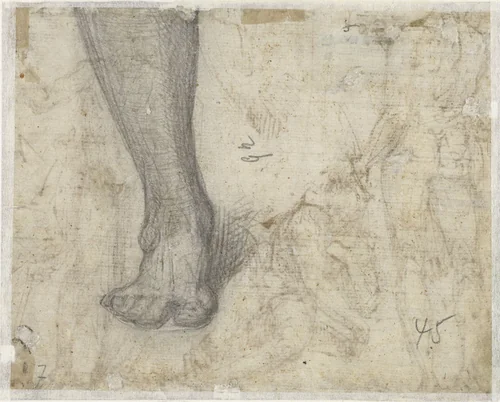
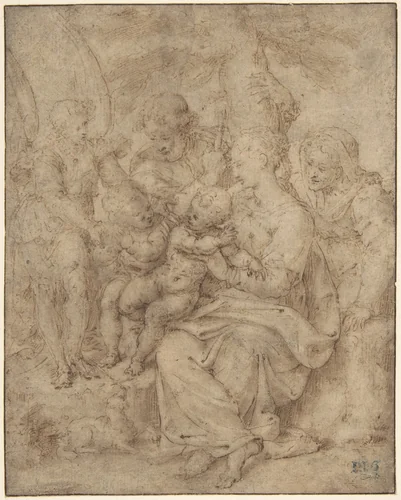
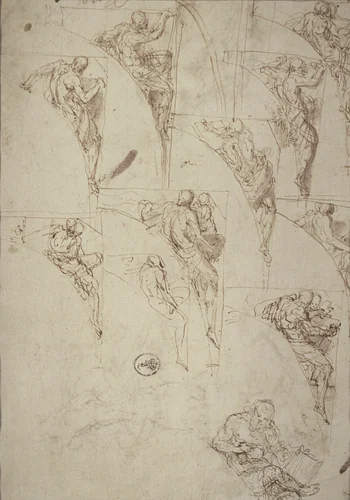
His output demonstrates considerable technical range. Works such as Voet, van voren gezien (Foot, seen from the front) showcase a rigorous dedication to anatomical observation, typical of Renaissance training. Conversely, his studies, including Studies for Prophets in Spandrels, reveal his ambition for large-scale fresco projects and monumental figure design. His sacred compositions, such as The Holy Family with the Infant Baptist, Saint Elizabeth, and an Attendant Angel, highlight his mature capacity to manage dense narratives and complex drapery, often resulting in figures who appear slightly more stressed than their counterparts in earlier Renaissance works.
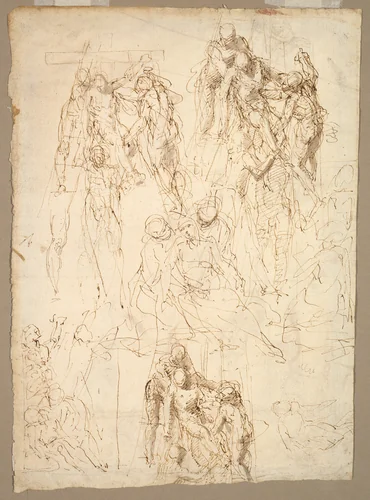
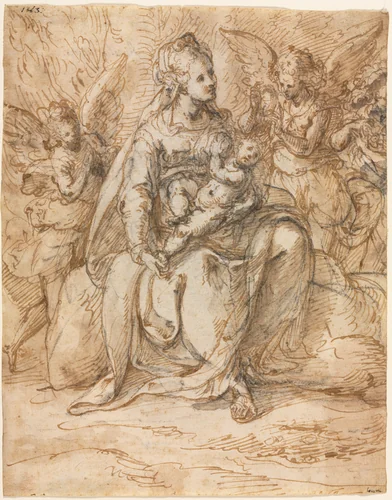
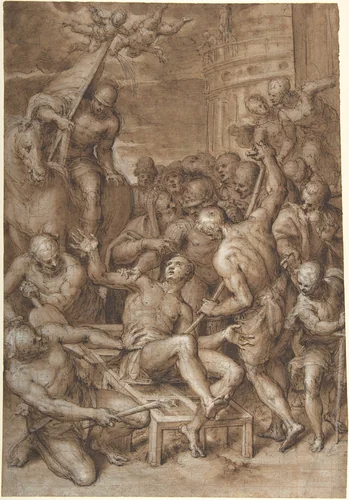
The technical proficiency required for Aurelio Luini’s complex compositional studies, such as Studies for the Deposition and Madonna and Child with Angels, ensures his place as a museum-quality draughtsman. Today, many of these essential drawings are held in major international collections, including the Rijksmuseum, the Metropolitan Museum of Art, and the Cleveland Museum of Art. The accessibility of his artistry has been further broadened by resources that place high-quality prints of his downloadable artwork in the public domain, allowing for continued scholarly engagement with this sophisticated Milanese artist.
Source: Wikipedia · CC BY-SA 4.0