Auguste-Rosalie Bisson
Auguste-Rosalie Bisson (1826-1900) was a pivotal figure in the second generation of French photography, sustaining a career that spanned nearly six decades. Born and based in Paris, he was the son of heraldic painter Louis-François Bisson and the younger brother and frequent collaborator of Louis-Auguste Bisson. While their joint efforts established the reputation of the Bisson Frères firm for detailed documentation of European architecture and monuments, Auguste-Rosalie’s individual distinction lies in his daring pursuit of the sublime through landscape.
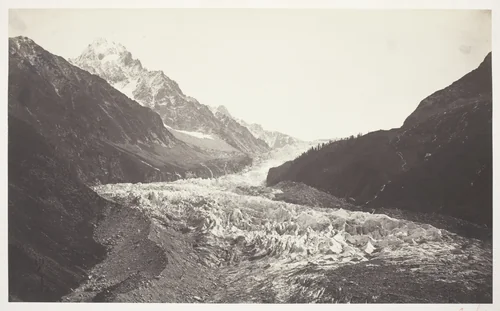
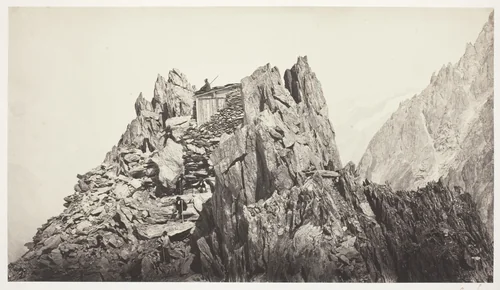
Bisson’s peak period of activity, roughly 1855 to 1861, cemented his status as a master of the ambitious landscape study, particularly documenting the colossal scale of the French Alps. Unlike contemporaries who focused solely on controlled cityscapes, Bisson devoted immense effort to documenting the newly accessible grandeur of the Mont Blanc region. This endeavor required him to haul cumbersome wet collodion equipment, including fragile glass plates and darkroom chemicals, across extremely rugged terrain.
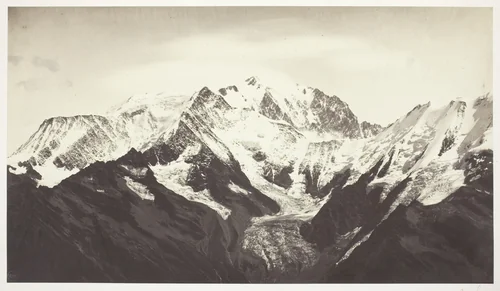
His resulting works, such as Savoie 46, Mont-Blanc, Vu de Mont-Joli and Savoie 48. Aiguille et glacier d’Argentières, represent technical and logistical feats. The wet collodion process demanded that exposures be prepared, exposed, and developed immediately, requiring temporary darkrooms to be set up on site, often in freezing, high-altitude conditions. It is a subtle irony of photographic history that the pursuit of such sublime, static grandeur required such dynamic, perilous effort.
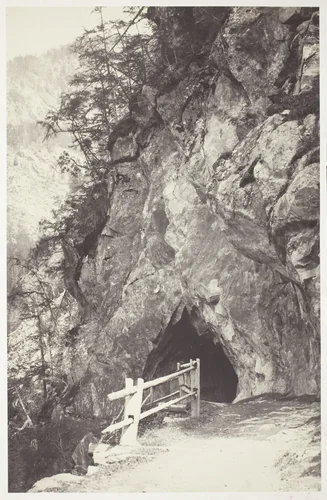
Bisson’s commitment to precision and scale ensured that his works quickly achieved a museum-quality standard instantly recognizable for their clarity and meticulous composition. His photographs, which include detailed topographical studies like Savoie 41, Tunnel de la Tête Noire, are held in prestigious international institutions, including the Metropolitan Museum of Art, the Art Institute of Chicago, and the Cleveland Museum of Art. Because many of these historic images have entered the public domain, researchers and collectors can now access high-quality prints and downloadable artwork, ensuring the continued study of Auguste-Rosalie Bisson’s profound contribution to 19th-century visual culture.
Source: Wikipedia · CC BY-SA 4.0
![[Basilica of Maxentius and Constantine, Rome] by Auguste-Rosalie Bisson, photograph, 1856-1866](https://img.artbee.org/7f70f392-7e29-40a6-978b-1f6c20d9b7b0/small.webp)
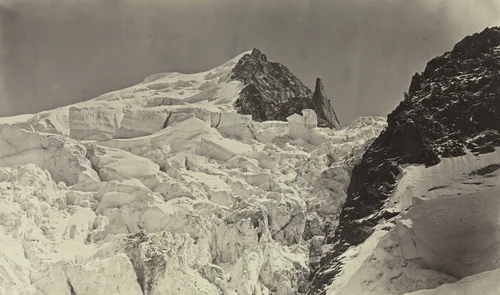
![[The Ascent of Mont Blanc] by Auguste-Rosalie Bisson, photograph, 1861](https://img.artbee.org/a894da98-b6f1-4211-b478-3a230325908c/small.webp)