Auguste Raffet
Denis Auguste Marie Raffet (1804-1831) occupies a crucial, if often understated, position within early 19th-century French visual culture. Known primarily as an illustrator and master lithographer, he devoted his active, though concise, career to visually codifying the recent past of the First French Empire. Raffet’s artistic trajectory began with training under Nicolas Toussaint Charlet, an established figure whose focus on military life greatly influenced Raffet’s thematic specialization as a retrospective painter of the Empire.
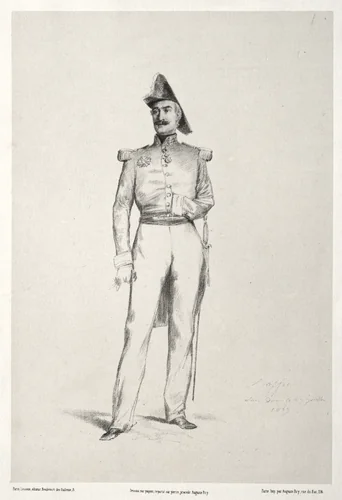
Raffet excelled in the rapidly developing medium of lithography, utilizing its capacity for broad, efficient distribution to shape popular memory. He was, in essence, the era’s foremost visual chronicler of Napoleon’s campaigns, often romanticizing the deeds of the Imperial soldier long after the final battles concluded. His ability to capture kinetic detail and emotional authenticity made his works highly popular. Prints such as Carabinier, the precise Five Equestrian Studies: Cavalrymen, and the dynamic Croisés en Campagne established the enduring iconography of the era’s military forces.
While deeply rooted in military genre, Raffet’s scope occasionally expanded to capture contemporary political tension, evidenced by the print Les Munitionaires du 28 Juillet, a work that touches upon the events surrounding the July Revolution. Raffet’s true achievement lies in transforming historical facts and anecdotes into compelling, accessible imagery. He helped mythologize the Napoleonic era, defining the image of the grognard (Old Guard) for generations of viewers. It is perhaps an amusing irony that the Empire's legacy was so often determined not by grand, official Auguste Raffet paintings, which were few, but by thousands of affordable, rapidly produced Auguste Raffet prints.
These high-quality prints remain essential documents for scholars and enthusiasts alike. Major institutions actively collect his work, affirming his historical significance; his drawings and prints are held in prestigious collections, including the Metropolitan Museum of Art, the National Gallery of Art, and the Cleveland Museum of Art. Because his prolific output utilized printmaking mediums extensively, many key images are now readily available in the public domain, ensuring that downloadable artwork remains accessible globally.
Source: Wikipedia · CC BY-SA 4.0