Auguste Edouart
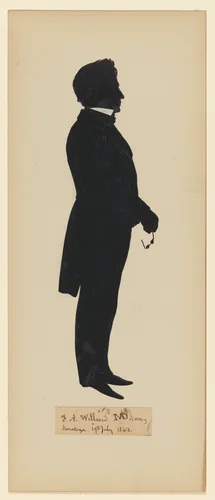
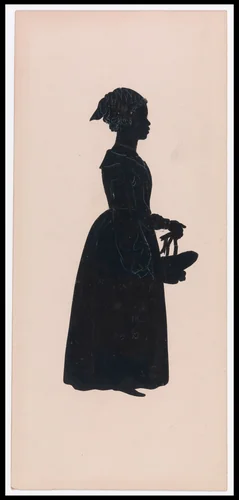
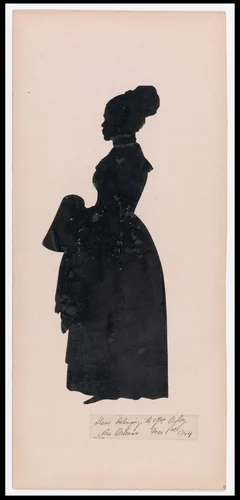
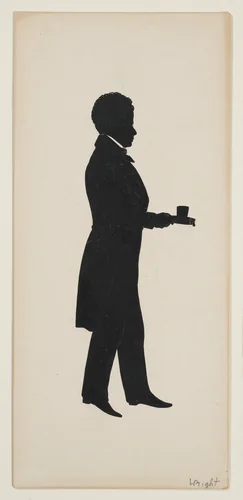
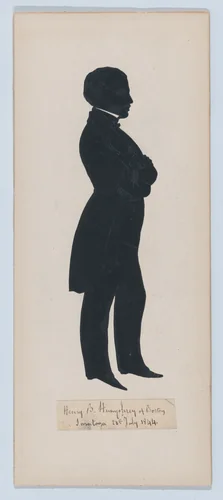
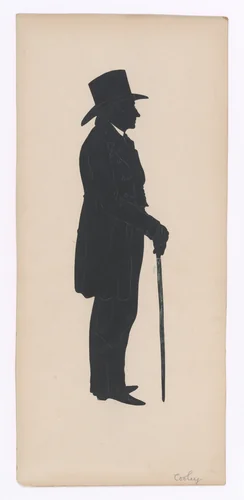
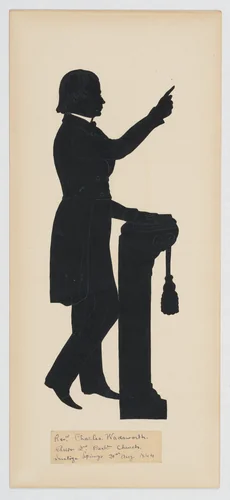
Auguste Amant Constant Fidèle Edouart (1789–1861), a French-born draftsman and portraitist, forged an unexpected yet enduring artistic legacy in the 19th century through the specialized medium of the silhouette. Working across England, Scotland, and the United States, Edouart transformed the simple profile cutting, often dismissed as a provincial craft, into a sophisticated and authoritative form of portraiture. He moved beyond the mere outline, focusing instead on capturing the full figure, posture, and characteristic movement of his subjects, establishing a rigorous standard for the genre.
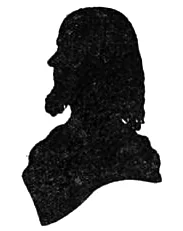
Active primarily between 1826 and 1841, Edouart’s dedication to anatomical detail and scale elevated his output far above that of his contemporaries. An Edouart portrait is often a large-format study, capturing subtle mannerisms and incorporating finely cut accessories and settings. This approach is evident in complex narrative pieces such as Kate and Harry Lucas, playing with a dog and a bird, where the precision of the paper cut is matched by the animation of the scene. His remarkable productivity ensured that his archives served as a vast pictorial census of the era, capturing statesmen, literary figures, and anonymous citizens alike. A surviving portrait of the celebrated author Sir Walter Scott demonstrates his ability to imbue the stark black profile with intellectual gravity.
Given his monumental, slightly theatrical name, it is perhaps a subtle personality element that Auguste Edouart chose the most economical and understated medium imaginable to document his world. He meticulously cataloged his thousands of works, often recording the sitter’s identity, date, and location in corresponding albums. This organizational rigor proved essential for preserving the historical significance of his cuttings, offering invaluable insight into the societal structure and fashions of the time.
Edouart’s contribution ensured that the silhouette earned its place within serious collections; today, important examples of original works and Auguste Edouart prints reside in institutions including the National Gallery of Art, the Metropolitan Museum of Art, and the Art Institute of Chicago. Because of the era of their creation and Edouart’s prolific output, a substantial body of his documentation is now within the public domain. This accessibility allows researchers and enthusiasts worldwide to examine the nuances of 19th-century portraiture, utilizing museum-quality reproductions and high-quality prints derived from his originals, reaffirming the enduring historical value inherent in his deceptively simple black paper profiles.
Source: Wikipedia · CC BY-SA 4.0