Armand Guillaumin
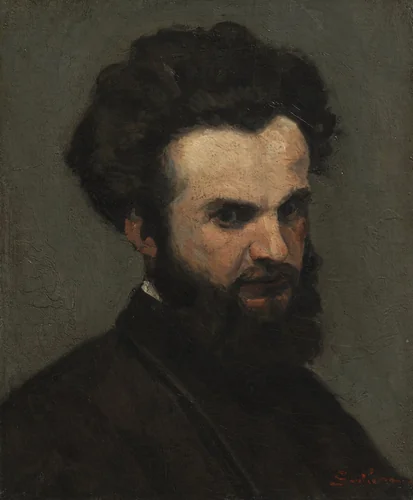
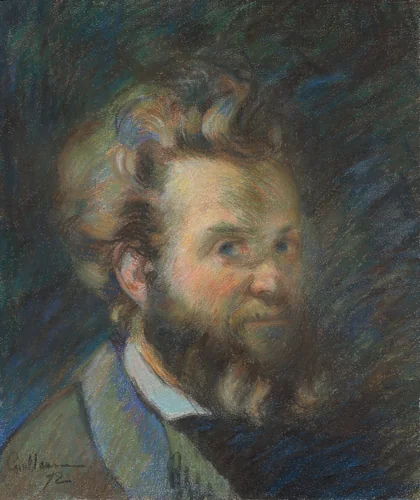
Armand Guillaumin (1841–1927) stands as a foundational yet often understated figure within the French Impressionism movement, recognized for his profound engagement with color and light. Active between 1872 and 1909, his output spanned painting, drawing, and lithography, consistently focusing on intimate Parisian industrial scenes and the vibrant landscapes of the French countryside, notably the Creuse Valley.
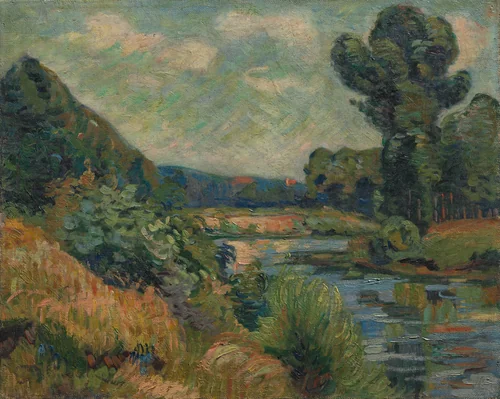
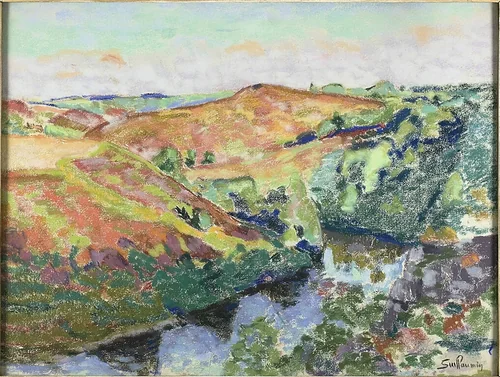
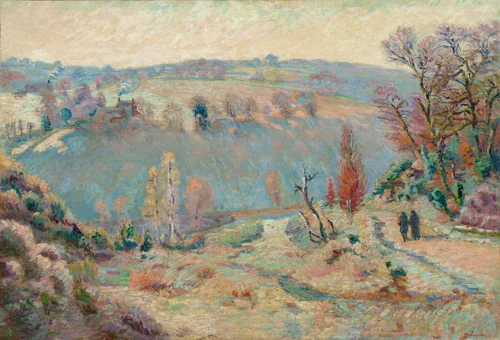
Guillaumin’s early career was defined by his radical alignment with pioneers like Pissarro and Cézanne, participating in several of the definitive Impressionist exhibitions. Unlike some contemporaries who softened their palettes, Guillaumin embraced chromatic intensity, using vigorous, often juxtaposed brushstrokes to capture the atmosphere of the moment. Works such as The Banks of the Marne at Charenton demonstrate his early sensitivity to the interplay between natural light and human-made structures, while later pieces like Valley of the Sédelle at Pont Charraud: White Frost showcase a mastery of specific atmospheric conditions, rendering the chilling air almost palpable.
A subtle personality element defining his career trajectory is the fact that his commitment to pure artistic exploration was only financially secured after he won a substantial lottery prize in 1891. This allowed him to dedicate the latter half of his life entirely to painting, traveling extensively and experimenting with increasingly bold coloration that anticipated later Post-Impressionist trends. His landscapes, including Landscape in Crozant, reveal a powerful, almost fauvist tendency toward saturated hues.
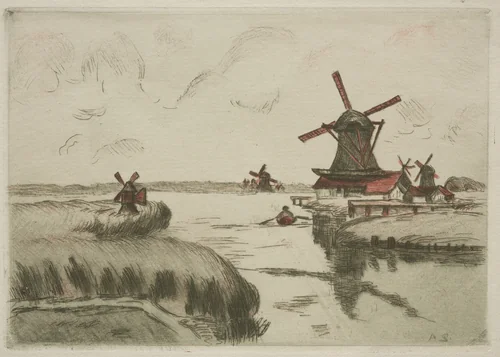
Guillaumin’s lasting importance is confirmed by the sustained inclusion of his work in major American institutions, with paintings and drawings held in the permanent collections of the Art Institute of Chicago and the Cleveland Museum of Art. The accessibility of his catalog has increased significantly, and many Armand Guillaumin paintings and his characteristic lithographs are now in the public domain, allowing institutions and enthusiasts access to high-quality prints and royalty-free images. Though he created only a small number of known prints, they are highly regarded for their textural innovation. His consistent and rigorous output ensures his place not merely as a participant, but as a vital colorist who pushed the boundaries of Impressionism far into the 20th century.
Source: Wikipedia · CC BY-SA 4.0