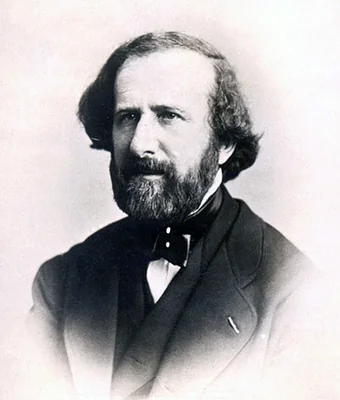
Armand Fizeau
Armand Hippolyte Louis Fizeau (1819–1896) occupies a unique dual position in nineteenth-century cultural history, recognized internationally both for defining a fundamental constant of the cosmos and for his ephemeral, yet important, role in the invention of photography. While Fizeau gained lasting scientific fame for his rigorous 1849 measurement of the speed of light, becoming the first person to achieve this without astronomical reliance, and for his subsequent 1851 Fizeau experiment measuring light’s velocity in moving water, his photographic activity coincided exactly with the medium’s chaotic birth.
Fizeau was active only between 1839 and 1843, a brief window during which Parisian streets were rapidly adapting to the emerging technologies of Daguerre and Talbot. His existing photographic oeuvre, comprised of only five known works, is characterized by its high technical quality and historical rarity. These pieces, now preserved in premier collections like the Metropolitan Museum of Art, offer a museum-quality perspective on the visual concerns of the earliest practitioners.
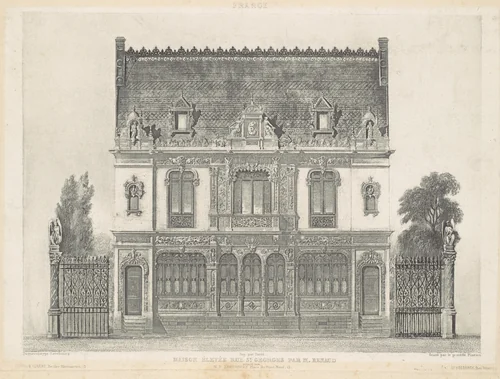
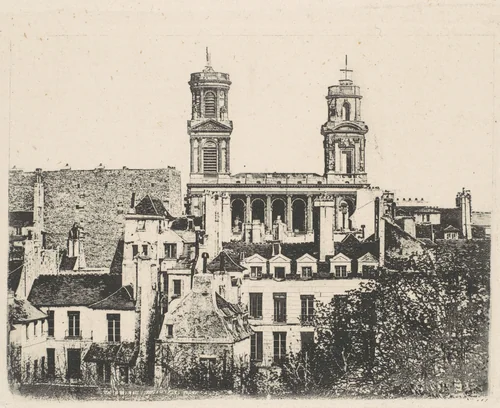
His chosen subjects reflect the period's focus on permanence and architectural documentation. Urban views dominate, including the finely detailed study Maison Élevée Rue St. Georges par M. Renaud and the careful framing of St. Sulpice, Paris. Even in the repetitive geometric abstractions of [Paris Rooftops] and [Rooftops, Paris], Fizeau demonstrated a precise visual calibration, perhaps foreshadowing the meticulous attention to detail that would characterize his later scientific endeavors. The inclusion of the portrait study [Man and Boy] further suggests an investigation into the medium’s full potential beyond mere architecture.
The subtle irony of Fizeau’s short-lived artistic career is compelling: the man who established the mathematical value of light through sophisticated apparatus first used it simply to capture a fleeting Parisian moment. His photographic legacy confirms that, for a few years, Fizeau applied his deep scientific interest in optics and light not just to physics, but to the nascent visual arts. Given their historical significance, many records pertaining to early Fizeau prints are now available in the public domain, offering unprecedented access to this pivotal period in visual history and allowing for the study and preparation of high-quality prints for scholarly research.
Source: Wikipedia · CC BY-SA 4.0
![[Man and Boy] by Armand Fizeau, photograph, 1840-1842](https://img.artbee.org/58bd8ebb-19e5-4291-867f-38be086ae314/small.webp)
![[Paris Rooftops] by Armand Fizeau, photograph, 1841](https://img.artbee.org/ae19de5b-a0fa-43fd-8dea-4f03046350d5/small.webp)
![[Rooftops, Paris] by Armand Fizeau, photograph, 1843](https://img.artbee.org/d7c4ccef-fd21-47b8-b37b-432970c89235/small.webp)