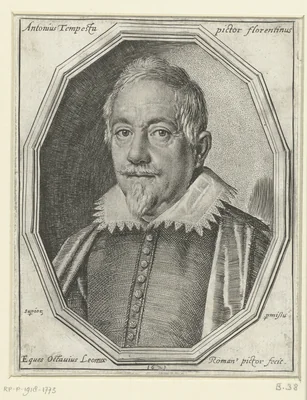
Antonio Tempesta
Antonio Tempesta (1555–1630), known to contemporaries as il Tempestino, was an Italian master whose extensive output in painting and engraving established him as a pivotal artistic connector between the stylistic traditions of late Mannerism in Rome and the expanding market for visual culture centered in Antwerp. His significance lies not only in his prolific output but in his successful synthesis of Italianate drama with the meticulous descriptive realism characteristic of Northern European printmaking.
While recorded as a painter specializing in large-scale history subjects, Tempesta’s most enduring influence rests upon his massive catalogue of engravings and etchings. His visual concerns were rigorously focused on military action, monumental historical narratives, and equestrian subjects. Works such as Battle Scene with Two Horses Attacking Each Other and the meticulously detailed Cavalry Attack on a Walled Fortress exemplify his unique ability to organize dynamic, kinetic chaos into legible, powerful compositions. These complex prints often involved dozens of figures, depicting the clash of infantry and cavalry with a narrative precision that transformed military engagement into high art.
Tempesta’s technical prowess facilitated the wide dissemination of his imagery across the continent, playing a crucial role in the development of print publishing during the early Baroque era. It is perhaps no surprise that an artist who specialized so intensely in chronicling high-stakes battles and swift cavalry movements dedicated an almost architectural rigor to his staging. Every movement, every soldier’s position, contributes to a dense but balanced scene. This attention to kinetic detail made his compositions, particularly his battle scenes, foundational prototypes for succeeding generations of artists seeking to capture the motion and immediacy of conflict.
Today, the original copper plates may be silent, but the legacy of Antonio Tempesta prints persists through major institutional collections worldwide, including the Art Institute of Chicago and the Metropolitan Museum of Art. Because many of his most important works are now in the public domain, enthusiasts and scholars may easily access high-quality prints of his graphic output. His sophisticated approach to visual narrative ensures that his mastery in depicting the energy of conflict remains a crucial touchstone for understanding late sixteenth-century European art.
Source: Wikipedia · CC BY-SA 4.0