Antonio Carracci
Antonio Marziale Carracci (active 1595-1609) was an Italian painter and draftsman operating within the influential orbit of the Bolognese school during the crucial transition to the Baroque era. He holds a unique, if minor, position in art history as the natural son of the celebrated master Agostino Carracci, placing him directly within the creative nucleus that redefined academic and classical painting at the turn of the seventeenth century.
While specific biographical details are scarce, Carracci’s technical skill and thematic scope are primarily assessed through his surviving works on paper. These drawings reflect the disciplined academic rigor championed by his family, masters who emphasized life drawing and precise composition as the foundation of grand historical art. His known output ranges widely, encompassing both the gravity of religious narrative and the spontaneity of daily observation.
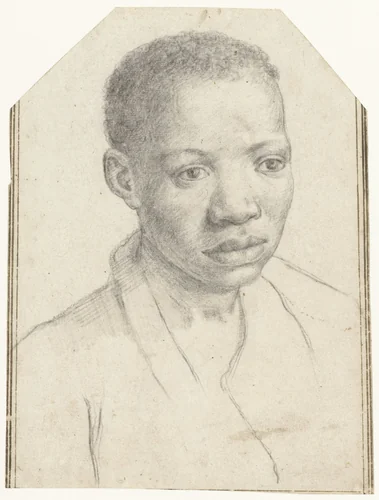
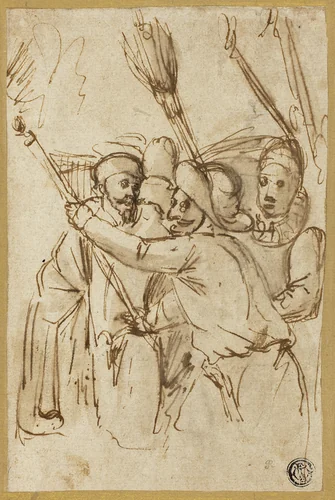
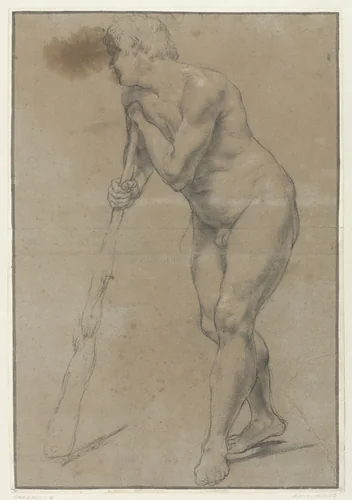
His portfolio includes complex figure studies displaying sophisticated anatomical understanding, such as the dynamic Studie van een naakte man die op een knots leunt (Study of a nude man leaning on a club), which contrasts starkly with his more anecdotal works, like the concise Portret van een zwarte jongen and the lively study of Carnival Figures. These works on paper reveal a hand capable of moving seamlessly between formal preparatory work and immediate, captured moments. This juxtaposition is key to understanding the versatility taught within the Carracci workshop.
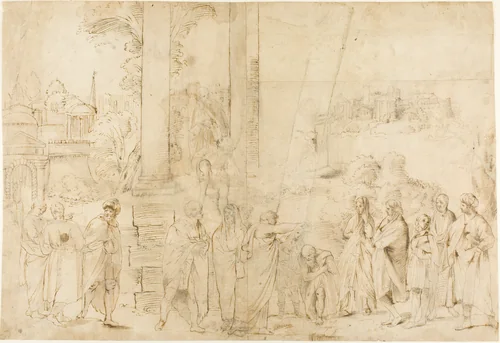
One of his most ambitious compositional drawings, The Virgin, the Holy Women, and Saints John, James and Joseph of Arimathea, with Christ on the Way to Calvary, displays a confident handling of crowded space and dramatic staging typical of the evolving seventeenth-century style. It is perhaps an understated observation that many of the most fascinating insights into the working methods of early Baroque masters are preserved not in their final oils, but in these highly resolved yet immediate drawings.
Carracci’s limited but telling body of work is secured in prestigious international institutions, including the Rijksmuseum and the Art Institute of Chicago. Owing to their prominence in museum holdings, access to Antonio Carracci prints and related scholarship is widespread. Many of these historical drawings are now available in the public domain, ensuring that high-quality prints and downloadable artwork remain accessible to a global audience for continued study and appreciation. His documented activity confirms his importance as a transitional artist whose visual language successfully integrated the academic discipline of the late sixteenth century with the burgeoning dramatic style of the early seventeenth.
Source: Wikipedia · CC BY-SA 4.0