Antonio Basoli
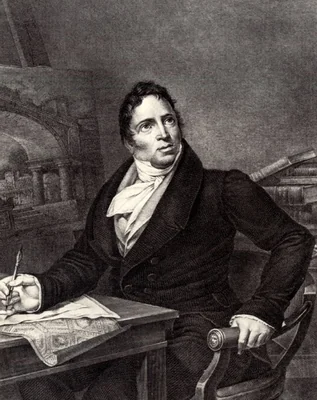
Antonio Basoli (1774-1848) was a pivotal figure in the visual culture of Bologna during the late eighteenth and early nineteenth centuries. Highly active in his native city, Basoli operated as a versatile creative professional, excelling as a painter, accomplished engraver, sophisticated interior decorator, and, most notably, a prodigious scenic designer. His extensive practice positioned him uniquely at the intersection of architectural tradition and the emerging theatricality of the Romantic movement.
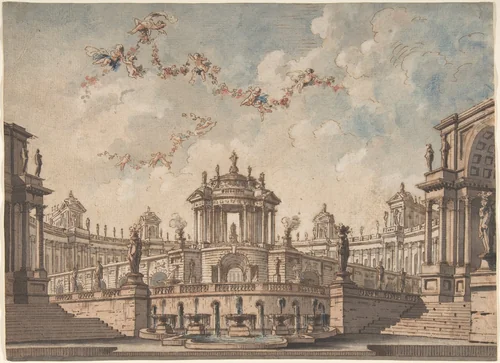
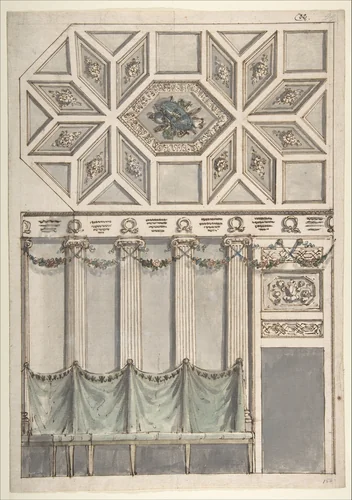
Basoli was a master quadraturista, specializing in the illusionistic depiction of grand architecture. His stage designs, widely documented through detailed drawings, reveal a capacity for monumental spatial organization. Works such as Design for a Stage Set: Semi-Circular Colonnaded Building, a Bridge Surmounted by a Tempietto, a Fountain in the Foreground and Putti Bearing Garlands exemplify his method: synthesizing rigorous classical forms with the dramatic scale required for opera and theatre. These designs required both an understanding of perspective geometry and an inventive flair, skills Basoli transferred seamlessly to interior design. His refined specifications for domestic spaces, seen in pieces like Framed Design for an Architectural Interior: Coffered Ceiling with Central Hexagonal Cartouche and Walls with Floral Ornament and Drapery, attest to his expertise in high-end neoclassical decoration.
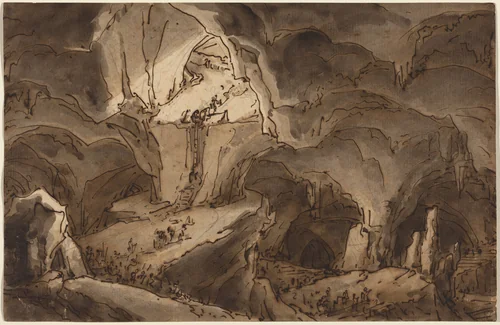
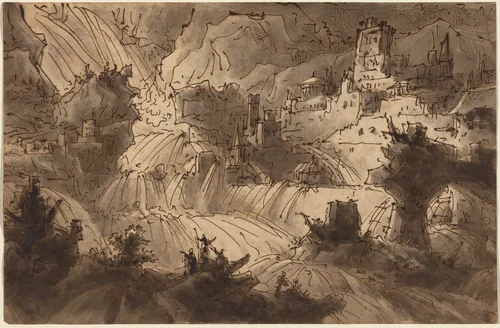
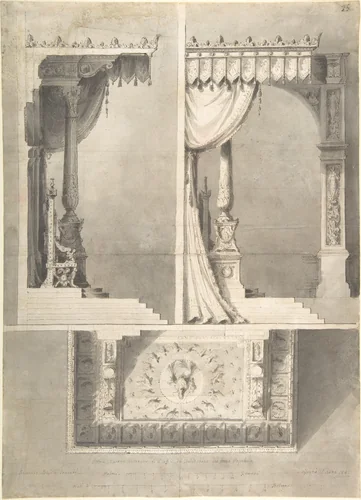
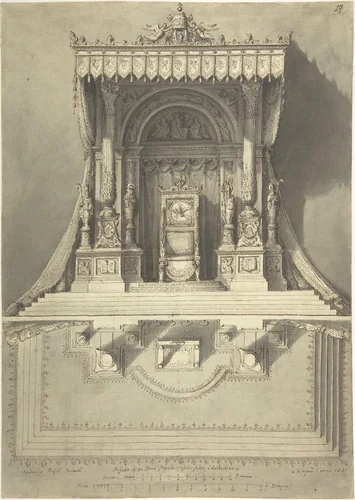
Yet, Basoli’s imagination often transcended practical stagecraft, particularly in his graphic output. He produced visionary architectural fantasies that moved into the realm of the sublime. Drawings like Entrance to the Bowels of the Earth and Mountain Torrents Flooding a City show a powerful, expansive imagination concerned not merely with decoration, but with overwhelming scale and natural catastrophe. It is fascinating to observe that the same artist who could calculate the precise specifications for a Design for a Papal Throne with Elevations and Sketch of Baldacchino Interior was equally capable of conjuring catastrophic, unbounded worlds.
Basoli’s prolific output of engravings ensured his designs circulated widely across Europe, securing his reputation. Today, his enduring legacy is maintained in major repositories, including the Metropolitan Museum of Art and the National Gallery of Art. His architectural sketches and dramatic fantasies are frequently studied; high-quality prints derived from his originals are often available as royalty-free downloadable artwork, ensuring that Antonio Basoli prints continue to influence contemporary design.
Source: Wikipedia · CC BY-SA 4.0