Antoine François Jean Claudet
Antoine François Jean Claudet occupies an essential, if often overlooked, position in the history of mid-nineteenth century photography. A French artist who established a formidable practice in London, Claudet was a dedicated master of the daguerreotype, the seminal photographic process that defined the medium’s earliest decades. Active primarily between 1840 and 1860, his work successfully bridged the gap between technical innovation and aesthetic purpose, cementing his importance in collections ranging from the Metropolitan Museum of Art to the Art Institute of Chicago.
Claudet’s output, constrained by the demanding and often unforgiving nature of the polished silver plate, demonstrates remarkable technical finesse. While operating a successful commercial studio, his experimentation extended far beyond standard portraiture. He was one of the first practitioners to explore complex multi-figure compositions and narrative genre scenes, moving the daguerreotype out of the realm of simple documentation and into deliberate artistry.
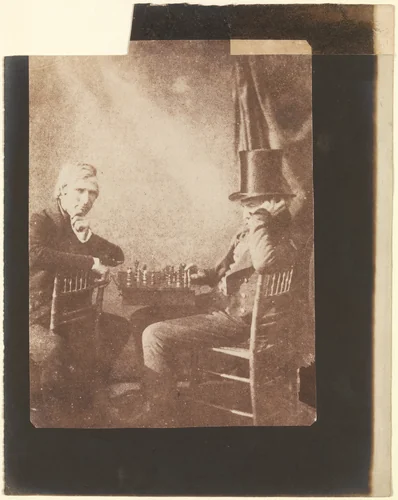
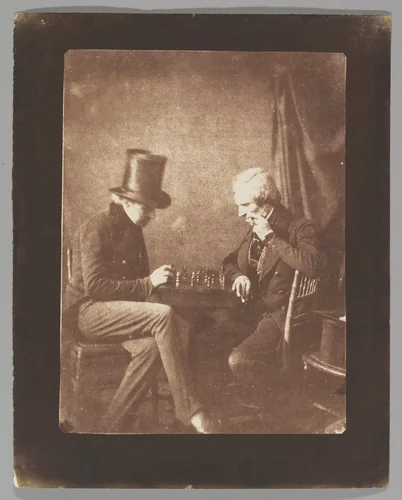
Key examples such as The Chess Players—which he documented in more than one version—reveal Claudet’s sophisticated approach to framing and light management, capturing nuanced interaction across the prolonged exposure times required by the process. Beyond interior scenes, his investigative curiosity shines through in works like the sequential Multiple Exposures of the Moon. It is perhaps a subtle testament to his scientific commitment that, while operating one of London's busiest photographic enterprises, he dedicated himself to repeatedly documenting celestial changes.
Claudet also utilized the stereoscopic technique, as evidenced by domestic scenes such as the Stereograph, Two Children Standing Between Furniture in a Studio Parlor Setting, which sought to imbue the static image with three-dimensional depth and a sense of intimate observation. This range, spanning technical diagrams and evocative genre studies, confirms his status as a pioneer. Given the scarcity of original photographic plates from this era, his sustained relevance today is bolstered by the fact that many of his earliest photographic explorations are now considered public domain. This shift ensures that high-quality prints and downloadable artwork allow contemporary audiences worldwide continued access to the foundational techniques of early photography.
Source: Wikipedia · CC BY-SA 4.0
![[Middle-aged Man with Glasses Holding Pocket Watch] by Antoine François Jean Claudet, photograph, 1844-1859](https://img.artbee.org/724e3cfd-2527-4cee-bc56-aec3a2e1aa5b/small.webp)
![[Multiple Exposures of the Moon] by Antoine François Jean Claudet, other, 1846-1852](https://img.artbee.org/ecc6a35c-1460-41d6-bd01-7341d17f56a4/small.webp)
![[Stereograph, Two Children Standing Between Furniture in a Studio Parlor Setting] by Antoine François Jean Claudet, photograph, 1853-1857](https://img.artbee.org/20d32ee3-f20a-44e6-b160-ed60248e42a1/small.webp)