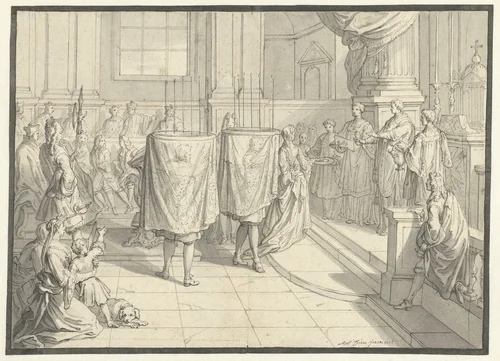
Antoine Dieu
Antoine Dieu (Paris, c. 1662-1727) was a prominent French painter of the late Baroque and early 18th centuries, specializing in historical subjects and court portraiture. Emerging from a family steeped in the graphic arts—his father, Edouard, and two brothers, Jean and Jean Baptiste, were successful engravers—Dieu received his foundational instruction under the monumental figure of Charles Le Brun. Working firmly in the grand manner established by his master, Dieu excelled in the rigorous classical style required by the royal academies of the era.
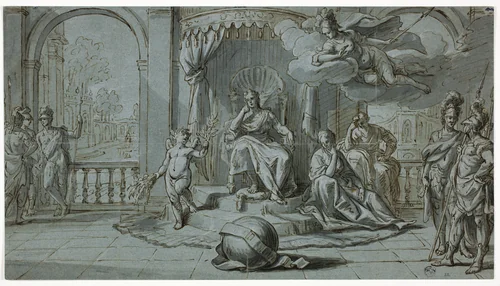
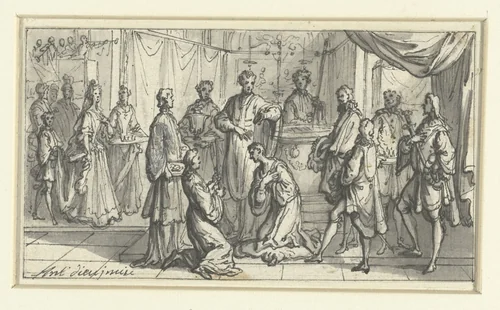
Dieu’s career was closely tied to the official artistic structures of Paris, culminating in his acceptance into the Académie Royale de Peinture et de Sculpture in 1722, though he had been actively executing major commissions for decades prior. His talent for chronicling royal events led to institutional works such as The Duke of Burgundy before the King and The Marriage of the Duke of Burgundy, both housed at the Musée National des Châteaux de Versailles et de Trianon.
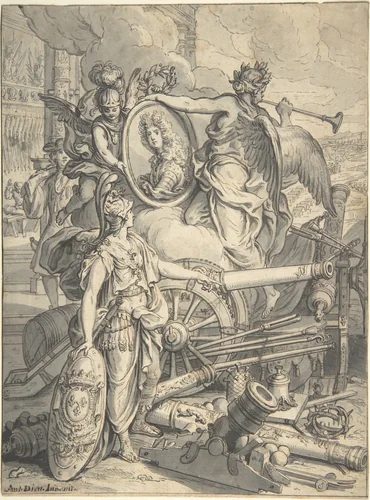
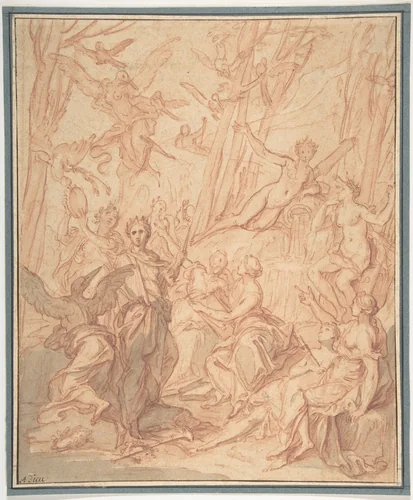
While these formal commissions solidified his institutional bona fides, Dieu demonstrated impressive narrative range across allegory and classical mythology. He often tackled challenging literary sources, as evidenced by detailed compositions like The Nine Pierides Transformed into Magpies after Their Unsuccessful Competition with the Muses (Ovid, Metamorphoses). Similarly, his careful studies for official tributes, such as Allegorical Homage to the Duc du Maine, Grand Maître de l'Artillerie, reveal the complexity demanded of a court painter. The enduring fascination with such highly specialized political flattery provides a gentle reminder that even the most rigorous academic artists sometimes needed to earn a living through strategically commissioned work.
Arguably his most definitive work remains the powerful state representation, portrait of Louis XIV. on his Throne, a piece so successful in establishing the monarch's majesty that it was widely disseminated through high-quality prints engraved by Nicolas Arnoult. Today, the continued interest in Antoine Dieu paintings is reflected in the fact that many of his drawings and preparatory studies are held in major international collections, including the Art Institute of Chicago, the Metropolitan Museum of Art, and the Rijksmuseum. Much of his significant oeuvre is now considered public domain, ensuring scholars and enthusiasts can access this detailed body of downloadable artwork.
Source: Wikipedia · CC BY-SA 4.0