Anne Truitt
Anne Truitt (1921-2004) was a pivotal American artist whose work rigorously interrogated the relationship between color, form, and verticality in three dimensions. While widely recognized as a major figure in the development of Minimalism during the 1960s, her approach remained distinctly personal, favoring layered applications of hand-brushed color that allowed her sculptures to interact dynamically with ambient light. This highly textural, yet precise, technique distinguished her from contemporaries who often prioritized industrial or machine-like finishes. Her early prominence was cemented by a major solo exhibition at the influential André Emmerich Gallery in 1963, positioning her oeuvre at the vanguard of new abstract sensibilities.
Truitt's core practice centered on large-scale, rectilinear sculptures built from wood and meticulously coated with successive layers of acrylic paint. This intense, time-consuming process, which required sanding down and re-applying pigment, created an optical depth that made the solid forms appear weightless or porous, subtly defying their inherent mass. The precision of her geometry coupled with the subtlety of her palette provided a contemplative experience for the viewer, inviting long-term engagement rather than immediate spectacle. A significant 1966 show at the Jewish Museum further broadened the critical reception of her innovative structures.
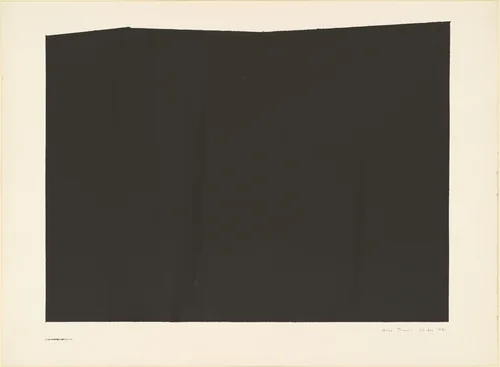
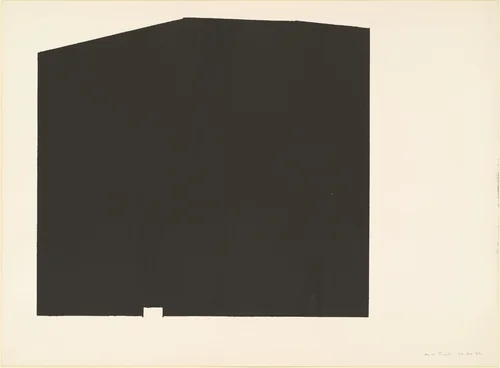
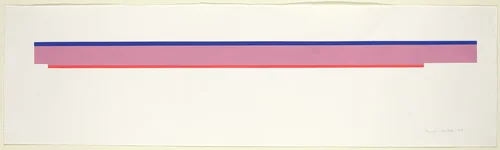
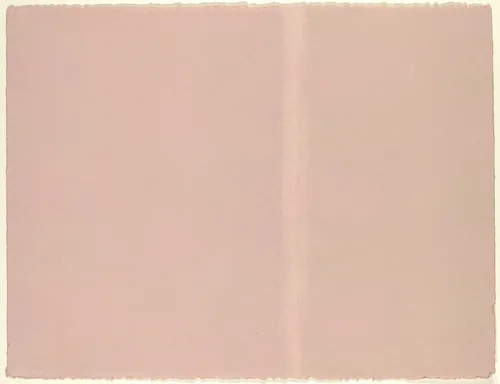
Though renowned primarily for her three-dimensional forms, Truitt also maintained an important parallel practice in two dimensions during her most active period, 1962-1974. These Anne Truitt paintings and drawings explored similar concerns regarding hue and planar definition, including works in the database like 4 Aug '71 and Sand Morning. The National Gallery of Art holds key examples of her diverse production.
Truitt’s methodical approach belied a highly sensitive artistic temperament; she consistently insisted that the final, seemingly simple color application was the true subject of the piece, not the physical wooden structure supporting it. This inversion of priority highlights her unique contribution to mid-century abstraction. Today, the clarity and intensity of her work remain highly sought after by major institutions, ensuring museum-quality placement in international collections. While certain high-quality prints derived from her graphic output may occasionally become available through archival sources, her original work demands an in-person viewing to appreciate the full, atmospheric effect of her signature color fields. Her legacy ensures her placement as a seminal figure whose pursuit of refined structure profoundly impacted American post-war sculpture.
Source: Wikipedia · CC BY-SA 4.0