Anne-Louis Girodet de Roussy-Trioson
Anne-Louis Girodet de Roussy-Trioson (1767-1824) occupies a complex and crucial position in the history of French art, serving as one of the pivotal figures who bridged the severity of late Neoclassicism and the emotional fervor of early Romanticism. Trained in the highly disciplined atelier of Jacques-Louis David, Girodet mastered the clear draftsmanship and precise composition demanded by his master. Yet, active across the volatile period spanning the French Revolution and the Napoleonic Empire, Girodet utilized this rigorous technique to explore subjects far removed from David’s classical austerity, injecting his works with psychological tension and, notably, subtle elements of eroticism.
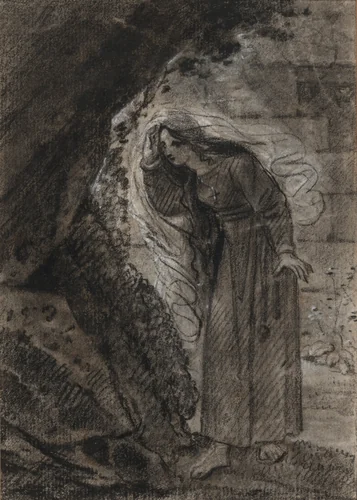
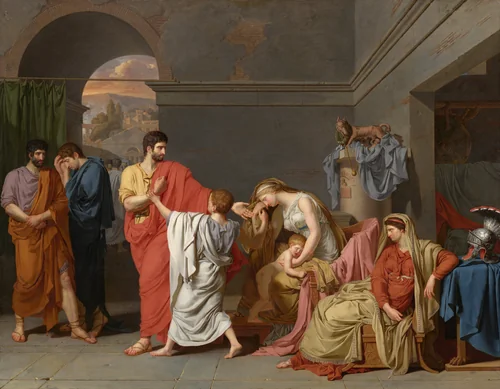
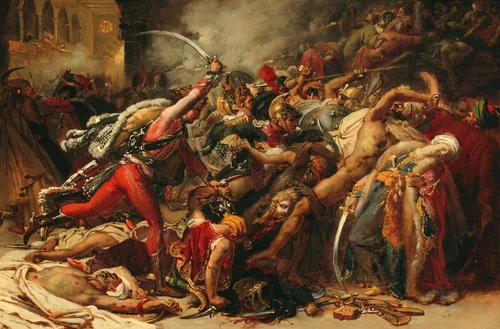
Girodet’s innovative style relied on this synthesis: the highly finished, academic surface supporting intensely charged themes. While capable of producing grand historical canvases such as Coriolanus Taking Leave of his Family, his unique sensibility is most apparent in his mythological and psychologically complex pieces. Works like Agnès Entering a Grotto hint at the melancholic sensuousness that defined his early contribution to Romanticism. Throughout his career, Girodet maintained a commitment to clarity of execution, a meticulousness evident in both finished canvases and preparatory pieces, such as the detailed Sketch for The Revolt of Cairo.
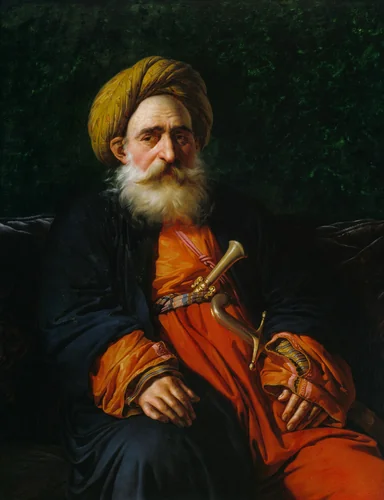
This precision and clarity made Girodet a key artistic chronicler of the new regime. He secured enduring fame through powerful portraiture for the Napoleonic court, capturing both the imperial ambition and the exotic reach of the era. His striking Portrait of the Katchef Dahouth, Christian Mameluke, for example, demonstrates his ability to combine formal academic structure with subjects reflective of contemporary geopolitical change. Girodet’s dedication to a museum-quality finish ensured his influence remained significant long after his active period concluded in 1816.
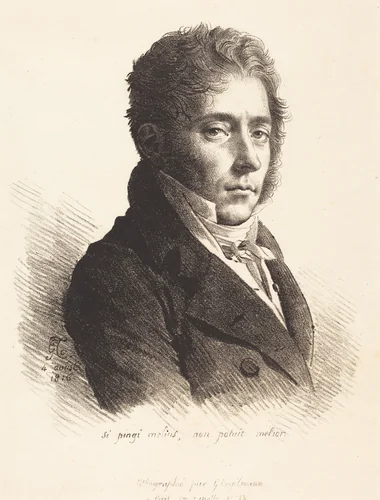
It is perhaps fitting that an artist so concerned with the transition between historical eras also chose to publish several tracts on literature, suggesting his gaze was always directed beyond the canvas itself. Today, the enduring interest in Anne-Louis Girodet de Roussy-Trioson paintings and prints means that many of his important graphic works, like Coupin de La Couperie, are widely accessible. Available as high-quality prints and downloadable artwork, many of these key works now reside in the public domain, ensuring this pivotal transitional figure remains accessible for contemporary study and appreciation.
Source: Wikipedia · CC BY-SA 4.0