Andreas Achenbach
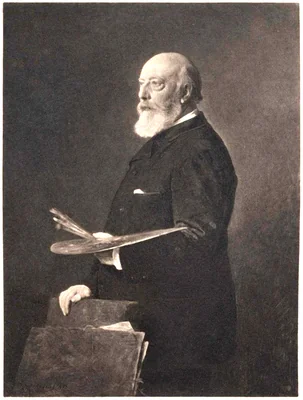
Andreas Achenbach (1815-1910) holds a foundational position within nineteenth-century German art, establishing himself as a master of both dramatic landscapes and evocative seascapes. He is widely recognized as a primary catalyst and co-founder of the influential Düsseldorf School of painting, a movement that profoundly shaped academic realism and the subsequent direction of Central European art.
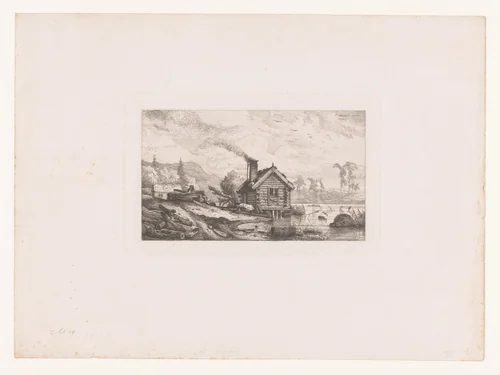
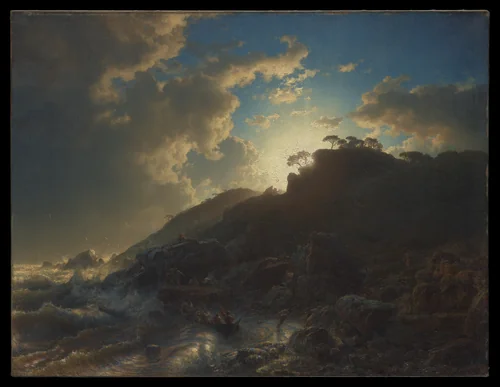
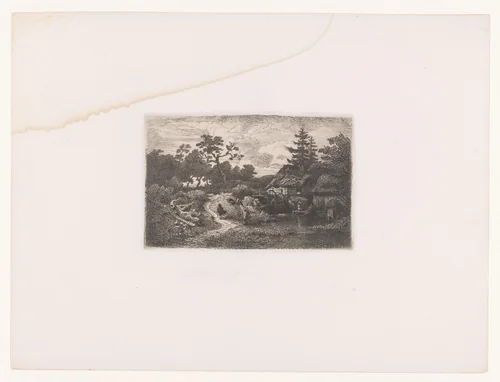
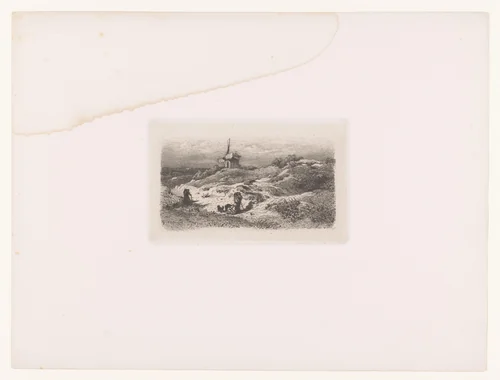
Working primarily within the late Romantic idiom, Achenbach possessed a keen eye for atmospheric drama and compositional intensity. His technical skill is evident in works that contrast human scale against the sublime power of nature, whether depicting turbulent maritime scenes, such as Sunset after a Storm on the Coast of Sicily, or serene pastoral vistas like Bosgezicht met een wandelaar en een watermolen. Unlike earlier, highly idealized interpretations common in the previous decades, Achenbach's approach often incorporated meticulous detail and a sense of direct observation, signaling a transitional movement toward realism while retaining the emotional depth characteristic of the Romantic era. His extensive body of work includes significant Andreas Achenbach paintings and numerous high-quality prints documenting these diverse subjects.
The historical importance of Achenbach extends beyond his own easel. His dedication to formal instruction and innovative technique helped cement Düsseldorf’s reputation as a center for artistic study during the mid-Victorian age. Curiously, Achenbach shared his chosen vocation with his younger sibling, Oswald. The two brothers, both celebrated landscape painters, became a fixture in the artistic dialogue of the era, earning the shared nickname “Alpha and Omega” of German landscape painters based on the sequence of their initials-an understated observation illustrating their perceived preeminence and influence within the genre.
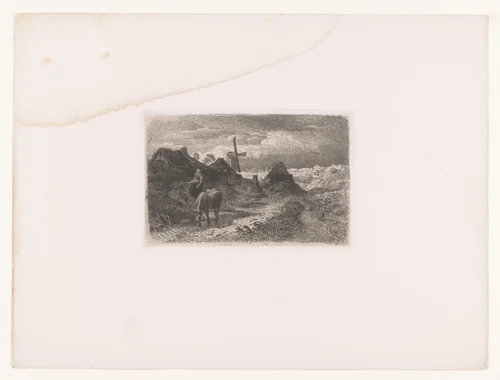
Achenbach's ability to transition seamlessly between brooding coastal scenes and tranquil inland compositions (such as Landschap met een molen, een vrouw en een grazende koe) ensured his enduring appeal. Today, his works are held in major institutions globally, including the Rijksmuseum in Amsterdam and the Metropolitan Museum of Art in New York. The accessibility of his artistry has increased through digitized collections, making examples of his royalty-free artwork and downloadable artwork available for contemporary study and appreciation worldwide.
Source: Wikipedia · CC BY-SA 4.0