Andrea Pozzo
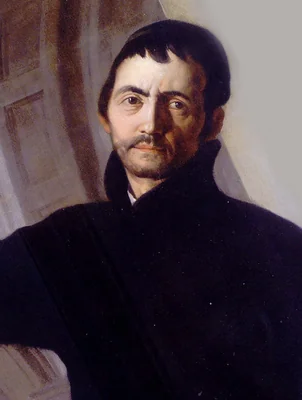
Andrea Pozzo (1642-1709) stands as one of the definitive polymaths of the Italian late Baroque, a Jesuit brother whose career spanned painting, architecture, stage design, and art theory. His comprehensive mastery established him not merely as a prolific practitioner but as the primary codifier of illusionistic spatial decoration in the late 17th century. Pozzo’s unique position within the Jesuit order provided him with unparalleled opportunities to execute monumental ecclesiastical commissions, transforming vast ceilings and vaults into celestial spectacles.
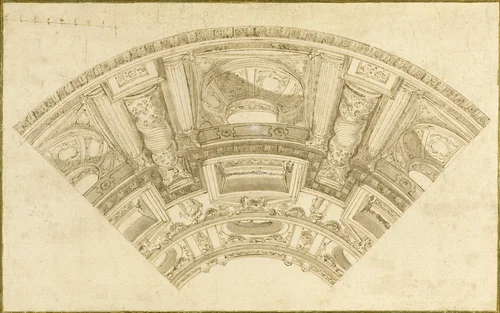
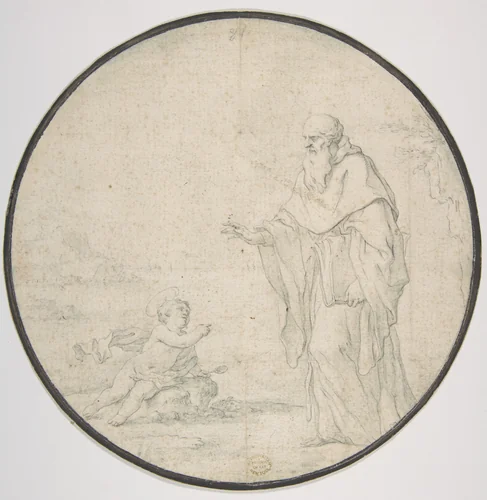
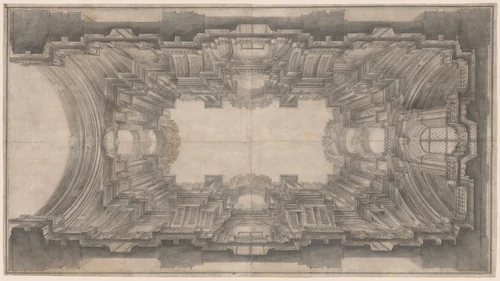
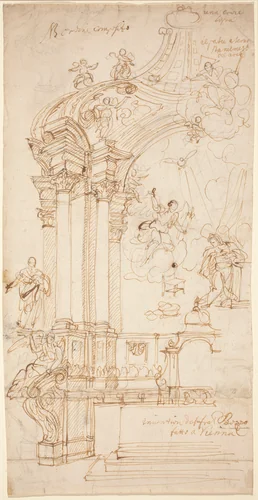
Pozzo’s historical importance centers on his innovative use of quadratura, the demanding sub-genre of trompe l’oeil designed to optically dissolve architectural boundaries. His crowning achievement, the massive painted extension of the ceiling at the Church of Sant’Ignazio in Rome, remains the ultimate demonstration of this art. Here, Pozzo was challenged by structural limitations that precluded a true dome; his genius lay in replacing the physical structure entirely with a breathtaking optical illusion, creating the painted dome known as Illusionistic Architecture for the Vault of San Ignazio. This work, alongside preparatory designs such as Design for Trompe l’Oeil Cupola, exemplifies his rigorous, almost mathematical, approach to transforming two dimensions into three. This dedication to perfect alignment made his work delightfully apparent, even in smaller-scale Andrea Pozzo paintings and drawings.
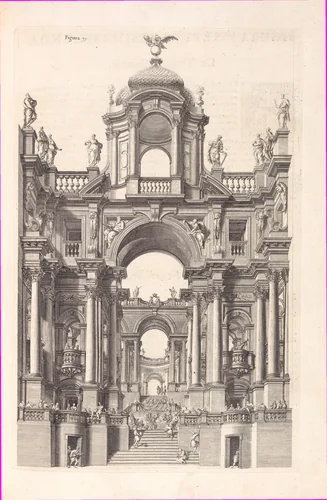
Crucial to his lasting impact was his 1693 publication, Perspectiva pictorum et architectorum (Perspective for Painters and Architects). This seminal two-volume treatise moved beyond personal technique, standardizing the complex geometrical principles required for convincing stage design and decorative quadratura. It rapidly became the essential instructional manual for European decorative painters throughout the 18th century. It is here that we find the subtle personality of the Jesuit master: meticulous, systematic, and entirely dedicated to making complex illusionism universally accessible. Today, many plates from this influential work, along with detailed drawings, are in the public domain, allowing enthusiasts access to this foundational resource for high-quality prints and academic study.
Pozzo's commitment to rigorous methodology ensured his enduring influence. His legacy, preserved across major institutions including the National Gallery of Art, the Art Institute of Chicago, and the Metropolitan Museum of Art, continues to define the apex of Baroque spatial deception.
Source: Wikipedia · CC BY-SA 4.0