Amico Aspertini
Amico Aspertini (1474-1530), also recorded as Amerigo Aspertini, was a foundational figure in the transition from the High Renaissance to early Mannerism within Central Italian art. Recognized as a leading exponent of the Bolognese School of painting, Aspertini’s career spanned the critical decades bridging the fifteenth and sixteenth centuries, during which he practiced prolifically across painting, sculpture, and highly distinctive draughtsmanship.
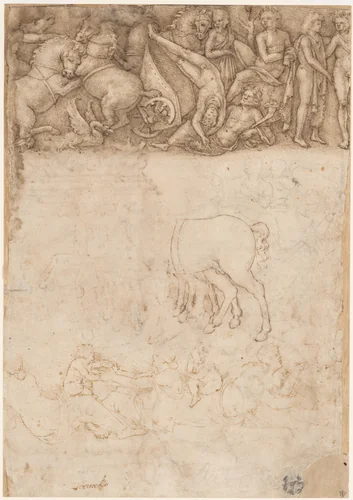
Aspertini’s style is best defined by its eccentric complexity and eclectic nature. His works demonstrate a sophisticated, scholarly command of classical antiquity, frequently incorporating detailed architectural studies and motifs borrowed from Roman sculpture. This dedication is starkly evident in his large-scale sketchbook pages, such as Studies after the Antique: The Fall of Phaëthon, Horses, Reclining Women with Children, which juxtapose intense classical observation with seemingly arbitrary compositions. Yet, this devotion to classical rigor consistently yields to expressive urgency.
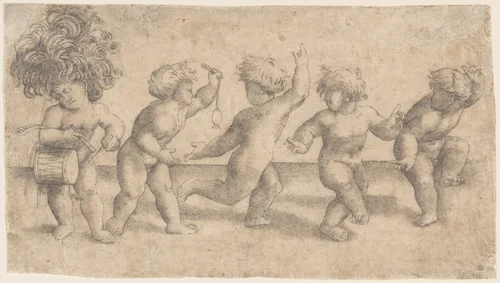
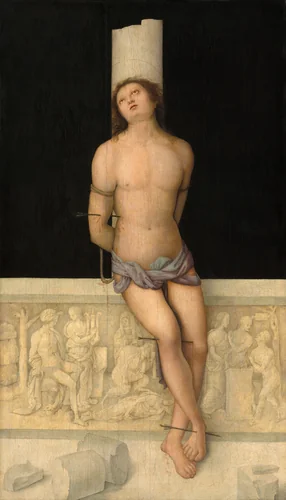
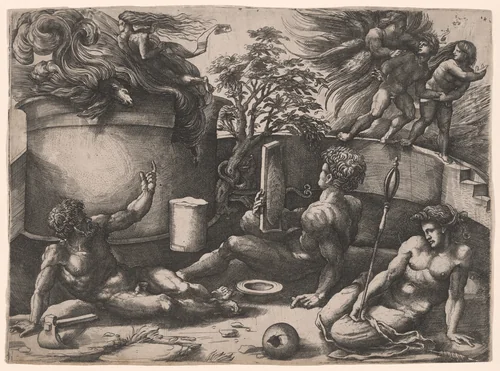
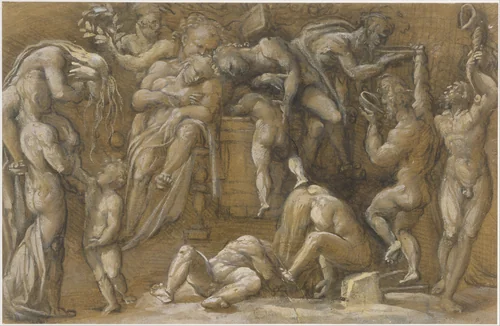
His figures, whether the contorted subject of Saint Sebastian or the agitated participants in a Bacchanalian Scene, often feature elongated proportions and deliberately unstable poses, foreshadowing the terribilità that would define the next artistic generation. His compositions, such as An Allegory on the Expulsion from Paradise and the Sacrifice of Abel, frequently push the boundaries of conventional spatial arrangement. One might say that Aspertini rarely met a classical form he didn't immediately intend to complicate.
The significance of Aspertini rests largely on his influential drawings and prints, which circulated widely and solidified his reputation as a master of restless invention. Today, examples of Amico Aspertini paintings and drawings are integral components of major institutional holdings, including the Metropolitan Museum of Art, the National Gallery of Art, and the Art Institute of Chicago. Owing to the inclusion of several of his key studies and prints within the public domain, art enthusiasts can access high-quality prints and downloadable artwork that capture the unique energy of this pivotal Italian Renaissance artist.
Source: Wikipedia · CC BY-SA 4.0