Alois Senefelder
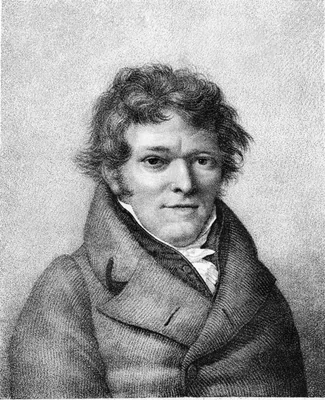
Johann Alois Senefelder (1771-1834) was an artist and writer who fundamentally altered the course of printmaking history. Although initially trained as an actor and playwright in Munich, Senefelder’s enduring significance stems not from the stage, but from the technical laboratory. Driven by the pragmatic necessity of economically reproducing his theatrical scripts and playbills, Senefelder invented the planographic printing method known as lithography around the 1790s.
This innovation, rooted in the simple chemical principle that oil and water repel, provided the first fundamentally new means of image reproduction since the development of movable type. Where traditional printmaking relied on the laborious carving or scratching of the matrix surface, lithography allowed the artist to draw directly upon limestone with a greasy crayon, achieving a spontaneity and tonal range previously impossible in etching or woodcut.
Senefelder’s period of artistic activity, documented from roughly 1803 to 1819, focused heavily on demonstrating the technical mastery and commercial viability of his new process. His crucial instructional volume, Art of the Lithograph, showcases this range, moving effortlessly between architectural precision, as seen in Hotel da Ville de la Rochelle, France, and detailed technical diagrams, such as Art of the Lithograph: Albanian, Plate XVIII and the finely rendered Art of the Lithograph: Psalter- Initial B, Plate VIII.
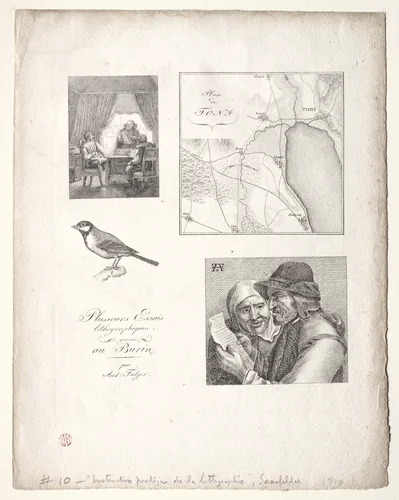
It is perhaps the greatest irony of Senefelder’s career that a pursuit of inexpensive theatrical reproductions resulted in a printing technique that rapidly became indispensable for fine art, cartography, and mass-market media throughout the nineteenth century. His legacy is one of technical liberation; he provided graphic artists with an immediate, fluid drawing surface that revolutionized visual communication. Today, collections worldwide, including the Cleveland Museum of Art, preserve the technical excellence of his original plates. Examples such as Art of the Lithograph: Four Engraving Samples, War Tent, Map of Toni, Bird, Dutch Farmer and Woman demonstrate the medium’s versatility. The survival of these early Senefelder prints, often entering the public domain, ensures that high-quality prints and downloadable artwork remain accessible for historical and artistic study.
Source: Wikipedia · CC BY-SA 4.0