Alfred Thompson Bricher
Alfred Thompson Bricher (active 1837-1892) secures his place in American art history as a pivotal late-nineteenth-century landscape and marine painter. Associated early in his career with both the Hudson River School and the specialization known as White Mountain art, Bricher helped transition American painting from the high drama of inland topography to the luminous, atmospheric study of the Eastern Seaboard.
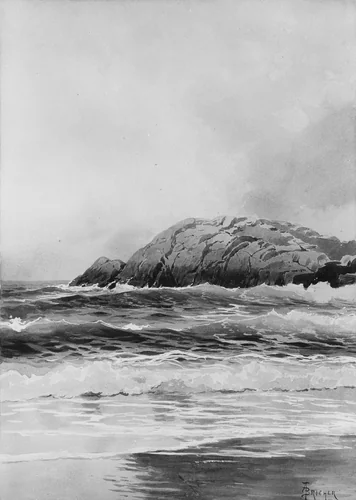
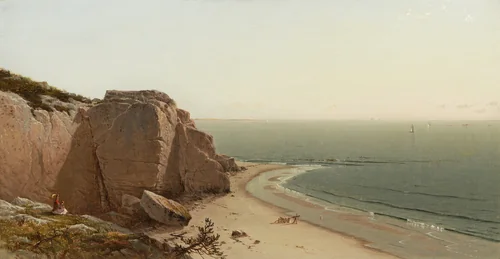
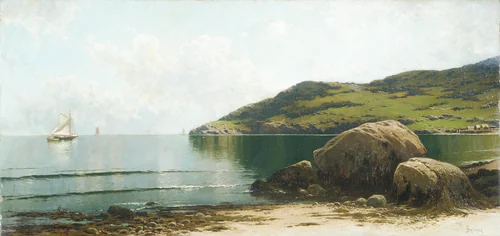
While many of his contemporaries sought the sublime grandeur of monumental mountains and remote wilderness, Bricher ultimately excelled in capturing the specific, nuanced beauty of the coastal environment. He became highly regarded for his ability to render the ceaseless motion of water, the specific textures of granite cliffs, and the diffuse effects of marine light. Works such as The Coast and Rocks and Sea exemplify his mature style, marked by a detailed naturalism that often lent his scenes a palpable sense of calm. His focus shifted from the sweeping vistas of the mountains to the quieter, rhythmically observed edge of the continent.
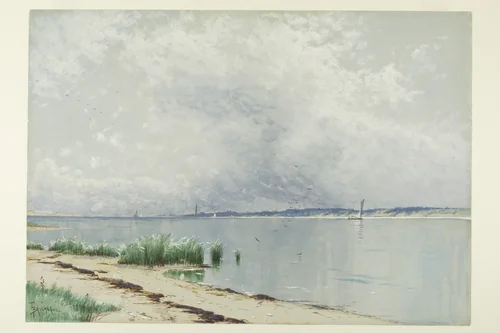
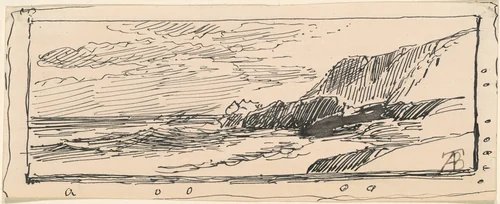
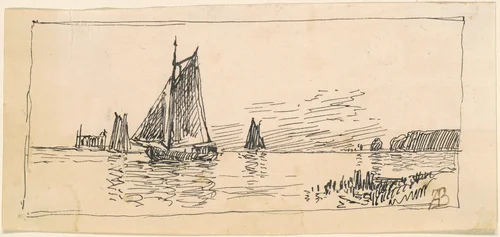
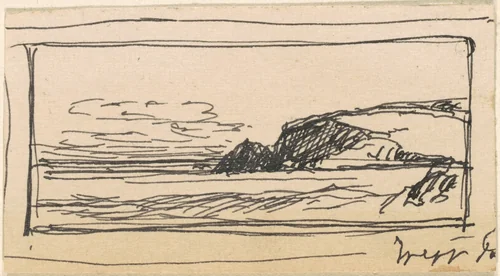
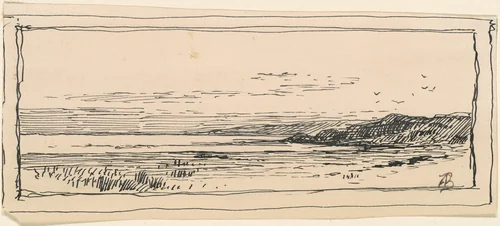
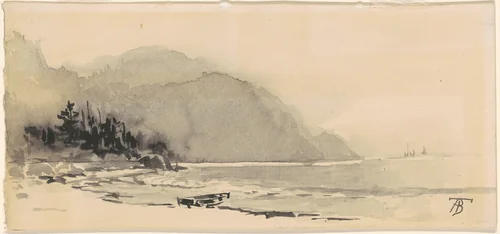
Bricher demonstrated formidable technical skill across media, moving fluidly between detailed preparatory drawings and large-scale oil paintings. His surviving corpus, which includes fine drawings like Reflected Reeds and Ships, illustrates his meticulous approach to capturing fleeting conditions. It is worth noting that while Bricher’s prolific output suggested constant travel, he was perhaps less interested in romanticizing distant frontiers than in perfecting the visual reality of his immediate surroundings, thereby making the familiar look newly extraordinary.
This sustained technical quality ensured that his best work achieved immediate institutional recognition. Today, Alfred Thompson Bricher paintings are permanent fixtures in esteemed American collections, including the National Gallery of Art, the Metropolitan Museum of Art, and the Art Institute of Chicago. As his works transition into the public domain, the precise draftsmanship and nuanced vision inherent in his coastal interpretations are becoming widely accessible. This expansion of availability, often through high-quality prints and downloadable artwork, allows a new generation to appreciate Bricher’s mastery of the American shoreline.
Source: Wikipedia · CC BY-SA 4.0