Alfred Jarry
Alfred Jarry (1873-1907) was a pivotal French writer and conceptual artist whose influence profoundly redefined the trajectory of twentieth-century European art and literature. Though emerging from the late nineteenth-century Symbolist tradition, Jarry is best known for the catalytic power of his 1896 play, Ubu Roi. This singular work shattered the restrictive conventions of contemporary drama, prioritizing grotesque caricature and linguistic chaos over bourgeois decorum, and remains a foundational text for the major avant-garde revolutions that followed.
Ubu Roi is widely cited as a direct precursor to the aesthetics of shock, irreverence, and calculated absurdity championed by movements such as Dada, Surrealism, and Futurism in the 1920s and 1930s. Later, the play’s themes of cynical, nihilistic authority provided the conceptual backbone for the theatre of the absurd in the 1950s and 1960s. Beyond the stage, Jarry established a complex philosophical concept he termed ‘pataphysics, defined loosely as the science of imaginary solutions and the study of the exception. This concept of the specific anomaly was central to his artistic output and continues to challenge conventional logic, securing his position as a crucial figure in conceptual art history.
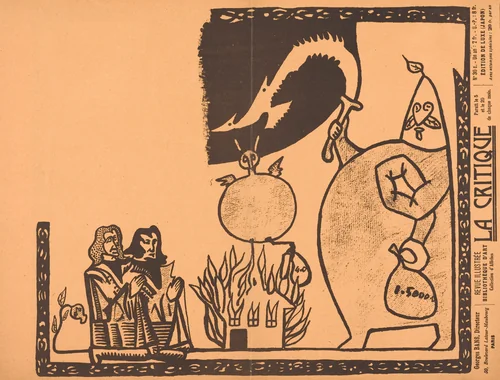
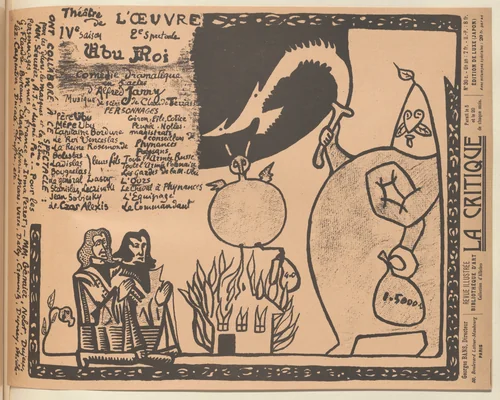
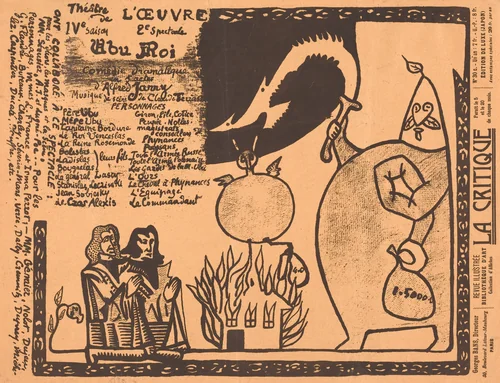
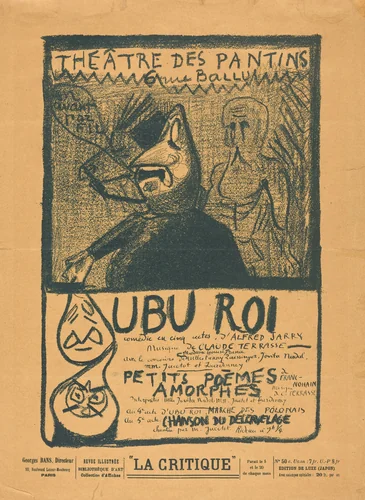
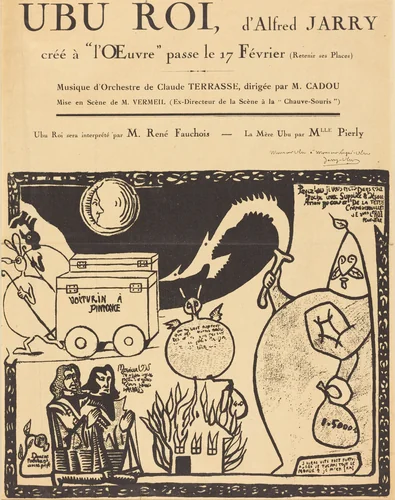
While Jarry is primarily known for his written works, the visual identity of his creations, documented through the development of associated prints, is critical to understanding his total artistic vision. These graphic outputs, including titles like Program for King Ubu (Ubu roi), provide essential context to the early shock waves his work sent through Parisian culture. Institutions such as the Museum of Modern Art and the National Gallery of Art hold examples of these graphic works, confirming his lasting significance in the development of modern media.
Despite his short life, marked by a commitment to innovation rather than volume, Jarry achieved profound impact. He notably dedicated himself to living life as a piece of art itself—a pursuit often fueled by high-speed cycling and copious amounts of absinthe, sometimes simultaneously. Today, his revolutionary texts and related Alfred Jarry prints are frequently found in the public domain, offering accessible, high-quality prints for study and appreciation worldwide.
Source: Wikipedia · CC BY-SA 4.0