Alexej von Jawlensky
Alexej Georgewitsch von Jawlensky (1864-1941) was a pivotal figure in the development of European Expressionism, providing a distinctly Russian sensibility to the radical artistic ferment active in Germany at the turn of the century. As a painter who committed his artistic life to Munich, he was instrumental in the intellectual and stylistic foundations of the German avant-garde, defining the period between 1900 and 1915 through an intense exploration of color and form.
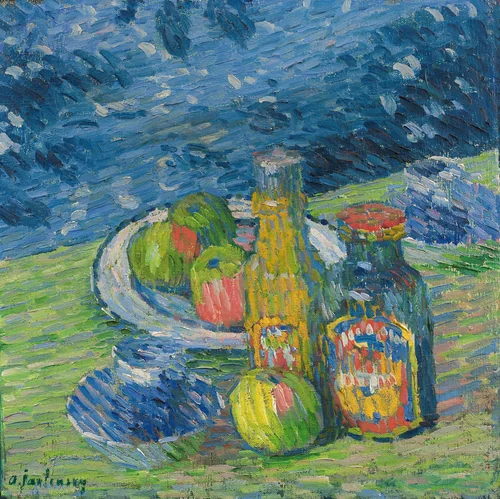
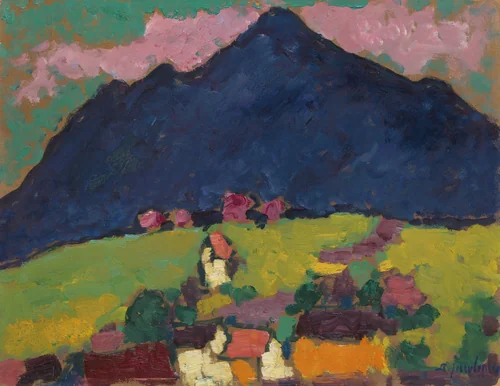
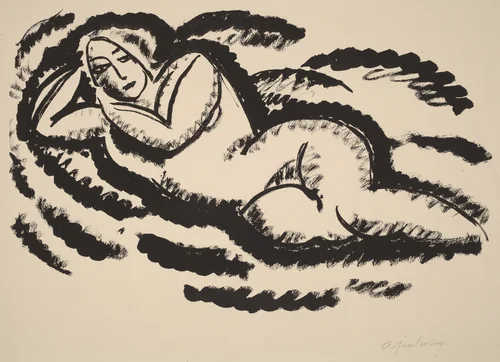
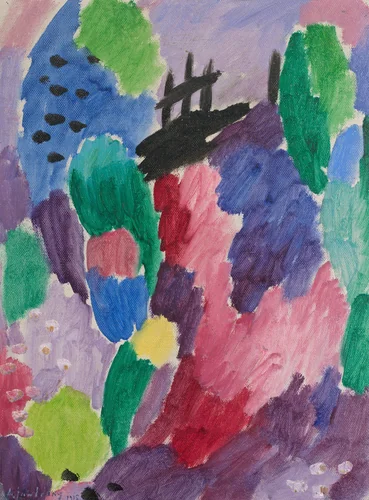
Jawlensky’s evolution reflects a deliberate transition from descriptive realism to a language defined by heightened emotional immediacy. Early works, such as the carefully structured Still Life with Bottles and Fruit, demonstrate an awareness of post-Impressionist color theory, which soon exploded into the bold, simplified compositions that characterized his contributions to Expressionism. Pieces like Murnau and the structurally simplified Reclining Nude showcase his increasing reliance on expansive color fields and heavy contour lines to convey a subject’s internal vitality rather than its external appearance.
His historical impact is inextricably linked to the groundbreaking artistic associations he helped found. Jawlensky was a key member of the Neue Künstlervereinigung München (New Munich Artist's Association) and later a co-founder of the seminal group Der Blaue Reiter (The Blue Rider). His work during this period, including paintings like Frosty Day, synthesized Western modernism with Orthodox icon painting, creating a powerful spiritual dimension that set him apart.
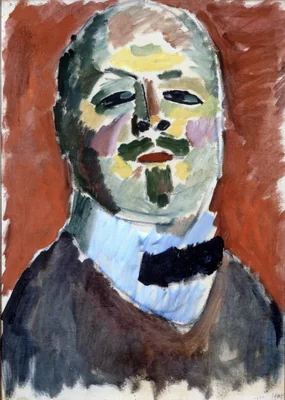
Jawlensky’s unique achievement was his sustained exploration of the human face as a vessel for spiritual truth. He began to paint series of abstracted heads, reducing the features to iconic, repetitive geometries, treating the portrait not as a likeness but as a meditation on color harmonics and formal reduction. This systematic inquiry into the face as a spiritual schema, a practice he maintained for decades, defines his late career. Later, as one of Die Blaue Vier (The Blue Four), alongside Kandinsky, Klee, and Feininger, Jawlensky cemented his legacy as a master of modern spiritual abstraction.
His inventive body of work, featuring key Alexej von Jawlensky paintings and distinctive visual artifacts such as the print Red Path, St. Prex, is preserved in leading institutions worldwide. Today, many of his important early pieces have entered the public domain, enhancing their accessibility and allowing scholars and enthusiasts to acquire high-quality prints of his essential contributions to modern art history.
Source: Wikipedia · CC BY-SA 4.0