Alexandre Denis Abel de Pujol
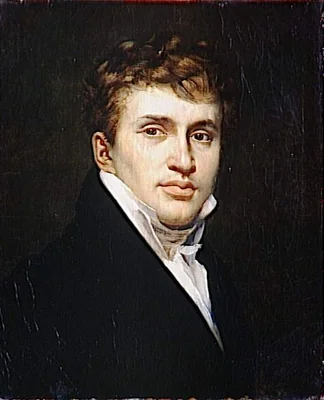
Alexandre Denis Abel de Pujol (1785-1861) was a preeminent figure in French Academic painting whose distinguished career spanned the Imperial and Restoration eras. A direct student of Jacques-Louis David, he inherited and successfully perpetuated the grand, rigorous principles of Neoclassicism, adapting them skillfully to the demands of monumental public commissions. His formidable institutional standing was confirmed by his election to the Institut de France and his designation as an officer of the Légion d’honneur, demonstrating his central and respected position within the Parisian art establishment.
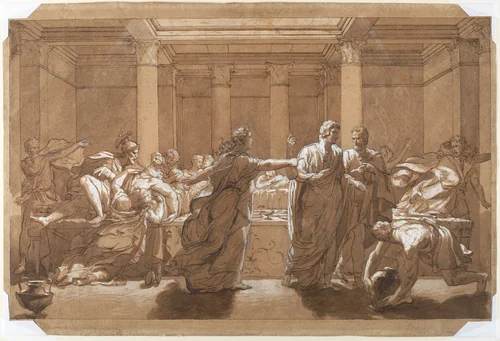
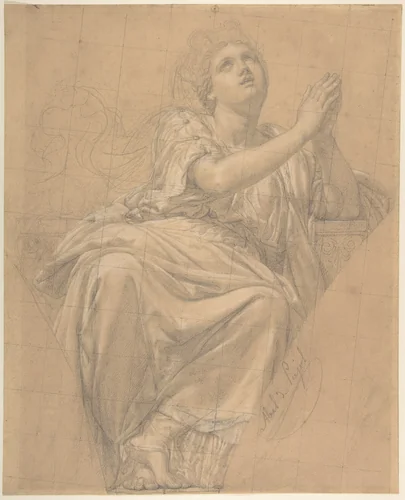
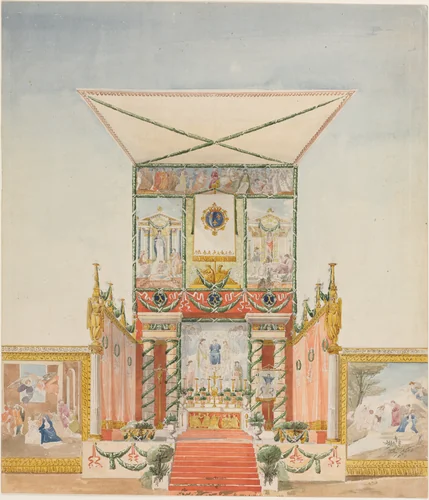
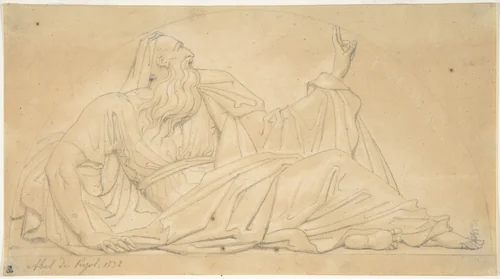
Pujol specialized in the vast decorative cycles necessary to define official French interiors of the period. His most visible achievements remain the large-scale architectural integrations in Paris, including the complex allegorical ceiling adorning the grand-staircase at the Louvre Palace, the sophisticated ceiling of the Bourse de Paris, and the elaborate painted decoration of the galerie de Diane at the Château de Fontainebleau. These expansive Alexandre Denis Abel de Pujol paintings exemplify the demands placed on academic artists to unify architectural space with highly refined historical and mythological narratives. The meticulous preparatory studies for these projects, such as the Allegorical Figure of the City of Piacenza, for a Pendentive in the Chapel of Saint-Roch held in the Metropolitan Museum of Art, showcase the immense intellectual and technical rigor required for such massive undertakings. Other examples of his preparatory work, including the designs for a Portable Field Altar for Charles X, reveal his versatility in adapting his classical style to royal patronage and functional objects.
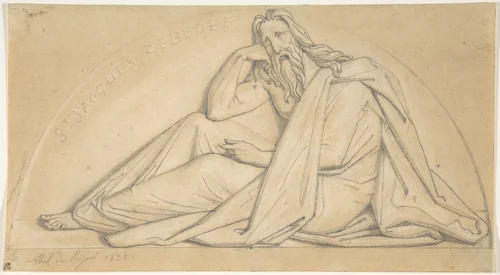
While rooted firmly in the Davidian discipline, Pujol’s influence extended beyond his own monumental output through his teaching. His studio was highly sought after, producing figures as stylistically diverse as the Romantic precursor Alexandre-Gabriel Decamps and the precise academician Émile Lévy. Pujol thus served as a fascinating, transitional figure, helping to bridge the established order of the Consulate with the emergent artistic voices of the mid-nineteenth century. Interestingly, the survival of his preliminary sketches and drawings, such as John the Apostle and St. Thomas the Apostle for the church of St. Vaast in Arras, often allows modern viewers a more intimate look at his inherent drawing talent than the sometimes overwhelming scale of his finished ceilings permits. Active professionally for decades, his commitment to clarity and draftsmanship remains evident in his extant drawings; today, many of these museum-quality preparatory works are available as downloadable artwork through institutional collections.
Source: Wikipedia · CC BY-SA 4.0